Go to Table of Contents --- Home --- List of Ancient Authors and Works

A B C D E F G H I J KL M N O P Q R S T U V W X Y Z


Glossary


active

In terms of sexual activity, the one who penetrates. I use the phrase bisexually active, however, to mean a person who acts on his sexual impulses with both sexes, rather than just feeling them and not acting on them.

agonos

A Greek word for non-reproducing, often used to describe eunuchs. See hagnos.

Akkadian

The ancient language of Mesopotamia from which are derived Assyrian and Sumero-Babylonian.

almah

A Hebrew word of uncertain meaning often translated as "virgin" or "maiden," although there is another word for virgin used more often, bethulah. I believe it may mean a women who prefers to avoid sex with men.

ancient

From an Old French word meaning "before," ancient usually refers to the period prior to the decimation of the western Roman Empire by Germanic barbarian invaders from the north, thus prior to the 500's CE.

aqim

An Arabic word meaning dry or unproductive.

Arabic

An ancient language related to Akkadian and Hebrew. The text of the Qur'an was revealed in Arabic.

assinnu

A Babylonian word meaning effeminate, but having a masculine grammatical ending. Probably an effeminate eunuch.

Assyria

The northern kingdom of Mesopotamia. A violent, horse-riding culture, it may be a northern Caucasian group which adopted a non-Caucasian language and cultural elements. Came to power in the middle of the second millennium BCE. The Assyrian language is a branch of the older Akkadian language.

Babylonia

The southern kingdom of Mesopotamia. The Babylonian language is a branch of Akkadian. I am not sure what the difference is, if any, between Babylonia and Sumer. Sumer is one of the world's oldest recorded civilizations. See Sumer.

BCE

Before the Common Era. An abbreviation used to avoid the Christian-oriented BC, or Before Christ.

bisexual

A word invented to describe people who either experience sexual desire for both sexes or who act on their sexual desire for both sexes. I argue that most people are bisexual in their sexual desires, even though only a very small minority are probably bisexual in their sexual activity, in European and American culture at least.

castration

Removal of all or some of the genital organs of a man or animal in order to make him unable to procreate.

catamite

A man or boy who prefers to be sexually passive.

Caucasian

Related to people or to descendants of people with white skin who may have lived in the Caucasus mountains many thousands of years ago, but who spread throughout Europe and western Asia during prehistoric times and eventually came down south in several episodes as barbarian warriors on horseback, destroying and appropriating more ancient civilizations.

CE

The Common Era. An abbreviation used to avoid the Christian-oriented AD, or Anno Domini ("the year of the lord").

church fathers

A phrase used to designate early theological thinkers of the centuries following Jesus whose ideas and political activities contributed to the establishment of the Catholic Church.

classical

Related to ancient Greece or Rome, or to ancient literature written in Greek or Latin.

Egyptian

An ancient language spoken and written along the Nile during the three millennia prior to Jesus.

environmental

Caused by or related to factors other than genes and chromosomes, such as diet, economic status, family life, or cultural value systems. See genetic.

eunouchos

A Greek compound word made up of eune and echein. Eune means bed and is taken to refer to the marriage bed. Echein is the Greek word for "to have" or "to hold" and can mean either "to be in charge of" or "to keep away from." Usually, eunouchos is analyzed to mean "the one in charge of the marriage bed" or chamberlain, but it could as easily be seen as "the one who keeps away from the marriage bed." There is a separate word in Greek for castrated men and boys, ektomias, which comes from the Greek word for cutting, temno.

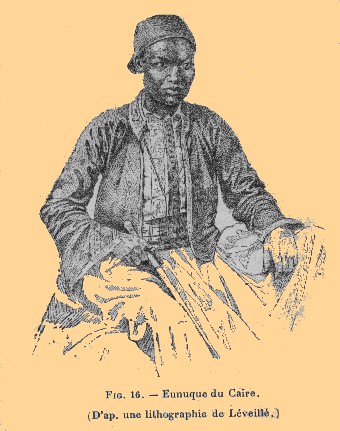
eunuch

Broadly speaking, a non-procreating man. Originally, a man who lacked the desire to have sex with women. The term has been extended to men who have been castrated, who are called man-made eunuchs.

eunuchize

Literally, to make into a eunuch, or non-procreating man. This may imply violent castration, but can also be viewed as making a person behave like a eunuch or take the role of a eunuch, without castration.

female

In modern European cultures, a person with an anatomically complete vagina, and lacking a penis. (If a penis is also present, the person is called a hermaphrodite.) In ancient cultures, a woman also had to be able to have children to be considered fully female.

gay

A colloquial term for a person who is exclusively or primarily attracted to sex partners of his or her own sex. Some also use the word gay for a person who is bisexual by genetic nature, but who chooses for social reasons to have sex exclusively or primarily with his or her own sex. I do not subscribe to this usage of the word gay, because I prefer to emphasize the genetic basis of people's sexual desire configuration.

gender

From a Latin word literally meaning "type" or "kind," gender is usually taken to refer to sexual types or roles. In modern European cultures, only two genders are acknowledged, male and female, but in ancient southern European and in non-European cultures at all times, hermaphrodites as well as men who were impotent with women were conceived of as belonging to a third gender, which, depending on interpretation, might be neither male nor female, or both male and female.

genetic

Caused by or related to a person's configuration of genes and chromosomes as inherited from his or her parents. See environmental.

genitals

The physical organs in the area of the groin which become intensely stimulated during sexual activity and which produce procreative fluids. Vagina, clitoris, penis, and testicles.

girsequ

A Sumero-Babylonian word for eunuch, mentioned in the Code of Hammurabi. See saris.

Greek

The language of the northern Caucasian invaders of the land now known as Greece. With the eastward spread of Greek influence by Alexander, it became a general language of intellectual life throughout the Middle East in the centuries prior to Jesus's birth. The Greek empire of Alexander replaced the Persian empire.

hagnos, hagias

A Greek word for holy, chaste, or pure. Hagnos may well be related to agonos, tracing the relationship between non-procreative status and holiness (hagnos = ha agonos, "the non-reproducing"). See qadesh.

Hebrew

An ancient language related to Akkadian and Arabic. Most of the text of the Bible is written in Hebrew. The word Hebrew comes from an ancient word meaning "to cross over." Whether the language Hebrew was spoken by a people who "crossed over" from Egypt (as described in the book of Exodus) is a matter of dispute. Hebrew is very close to Phoenician, the language of a sea-going Canaanite people living in what is now Lebanon, who maintained trading settlements throughout the Mediterranean.

hermaphrodite

A person born with female and male genital organs.

heterosexual

A word invented at the end of the nineteenth century mixing Greek heteros (the other) and Latin sexus (sex). It can describe any interaction between men and women, or males and females, but it is usually meant to describe sexual activity. It was invented not to describe a particular configuration of sexual desire, but rather to be the opposite of "homosexual." In fact, while most Westerns restrict themselves to heterosexual sex because of the taboo against homosexual sex, very few people can really claim to be genetically heterosexual.

hijra

An Indian word for a homosexual and/or transgendered effeminate man who has joined a group of other hijras, and who may have undergone a traditional castration operation. The word hijra is derived from Persian hiz, meaning "ineffective, incompetent -- one who does not have impact" from "a male point of view...He looks like a man, but is not a man" (source: Muzaffar Alam, quoted in Jaffrey, The Invisibles, p. 144).

holy

A Germanic-derived word meaning whole. It is used in English translations of the Bible to translate the Hebrew qadesh and the Greek hagias or hagnos. See qadesh and hagnos.

homophobia

Fear or discomfort about the idea of affection, especially sexually expressed affection, between people of the same sex.

homosexual

A word invented in the nineteenth century mixing Greek homos (the same) and Latin sexus (sex). Literally speaking, it can describe any interaction between people of the same sex, but the word was invented to describe people who are sexually attracted only to their own sex. This word is a great source of confusion. While it does describe the sexual activity of gay people, not only gay people can engage in sex with their own sex. Non-homosexuals can also engage in homosexual sex.

impotence

A man's inability to achieve a penile erection, either in general or in certain sexual situations.

kalaturru

A Babylonian word used in parallel to kurgarru in a myth about the creation of men who are unsusceptible to feel lust for women.

khasi

The main Arabic word for eunuch. May be derived from the root kh-S-S, meaning special or particular.

kliba

An Indian word for eunuch. Effeminate klibas are sometimes called hijras.

kulu'u

A passive sexual partner for men working in a temple of the goddess Ishtar or Inanna.

kurgarru

A Babylonian word for a eunuch priest in a temple of the goddess of love and war, Ishtar or Inanna.

Latin

The official language of the Roman empire, which was adopted as the official language of the western Catholic Church.

law

That which is "laid down." Law can be written or unwritten. Unwritten law can be simply the way things are done or the ways things work best. Written law is a relatively recent phenomenon of the last four or five thousand years. It became necessary as a way of keeping track of agreements and preventing lies and disputes, once human beings could no longer be trusted to act honestly and wisely without written laws.

lesbian

A gay woman. The term lesbian is also sometimes used to describe genetically bisexual women who have sex exclusively or primarily with women. In this web site, I use the term lesbian only for women who have no desire for sex with men.

lust

Sexual desire, usually taken (but not by me) to mean excessive desire. I use the term to describe a neurological mechanism that makes a person want to mix bodily fluids with another person in a sexual manner. If there were no lust, I believe no one would ever have sex.

majbub

An Arabic word meaning "what is cut." It comes from the root j-b-b, meaning "to cut." As a term for a castrated men, it means a man whose genitals are cut off, either completely or partially.

male

In modern European cultures, a person with an anatomically complete penis and testicles. In ancient cultures, a man had to be able to use his genitals for procreation to be considered male, so men turned off by and impotent with women were not included in the male category.

mamsuh

An Arabic word meaning "what is wiped." It comes from the root m-s-h, meaning to wipe or anoint. As a term for a castrated men, it probably means a man with with his testicles and penis removed, whose groin is thus "wiped clean."

man

A person born with a penis and testicles and no vagina.

mut'a

An Arabic word meaning "enjoyment," mut'a was a form of legal marriage contracted between a man and a woman for a predetermined period of time.

nature

A Latin-derived word literally meaning "what will be born." A famous German playwright, Friedrich Schiller, once defined nature as "that which is, in and of itself." Nature is usually contrasted with art, which is what mankind does by free will.

passive

In terms of sexual activity, the one who is penetrated.

pheromone

One of a group of gender-specific hormones emitted by certain animal species which alerts potential sex partners of the same species to an opportunity for sexual intercourse. I believe that human beings are generally susceptible to pheromone stimuli from either men or women, and that gay people may be insensitive to the pheromones emitted by the opposite sex.

priest

A person entrusted with spiritual matters, and called upon to provide guidance to the general population.

primary sources

Original texts by ancient authors.

procreation

Literally "creation on behalf of," procreation is the generation of new individuals as a result of heterosexual intercourse.

qadesh

A Hebrew and Akkadian word referring to temple priests who serve sexual functions. A female sexual priest is called qadeshah in Hebrew, qadishtu in Akkadian. In Hebrew, qadesh is the word for "holy."

racism

A social system in which people of one race hold and exert power over people of another race.

Roman

The civilization established twenty-five hundred years ago in the land now known as Italy, perhaps with influences from the Caucasians of western Asia Minor. It spread throughout the Mediterranean, taking over power from the successors of the Greek empire.

saint

A word derived from Latin sacer, which can mean both holy and cursed. It is telling that in Caucasian cultures the idea of holiness is tied up with the idea of condemnation, since gay people, who are revered as spiritual guides in non-Caucasian cultures, are condemned in Caucasian cultures.

salzikrum

A Sumero-Babylonian word literally meaning "male woman." Used in the Code of Hammurabi for a type of woman with special inheritance rights.

saris

An Assyrian word thought to mean literally "at the head," but used from the earliest recorded texts to refer to men who are not male. It may be a cognate to the Babylonian girsega or girsequ. Imagine a root word with the consonants s-g-r-s-g, and first remove the g-sounds. You are left with s-r-s, or saris. Returning to s-g-r-s-g, remove the first prefix, and you have g-r-s-g, or girsega/girsequ. Thus the difference between saris and girsequ may be nothing more than a dialect difference.

secondary sources

Modern academic works which present evidence about and interpretations of ancient texts.

sexism

A social system in which people of one sex hold and exert power over people of another sex.

sexual orientation

A confusing modern term used to describe a person's configuration of gender and sexual desire. In this concept, a person who is attracted only to his or her own sex is homosexual, while a person who is attracted only to the other sex is heterosexual, and if one is attracted to both sexes, then he or she is bisexual.

spado

The Latin word for eunuch. Latin also had a lesser used loan word from Greek, eunuchus.

sterility

The inability to reproduce, either due to impotence, anatomical defect, or inability to produce eggs or sperm. Note the current association between sterility and cleanliness, as in a sterile needle. The association between non-reproductiveness and purity is very strong and very ancient.

straight

A colloquial term for a person who avoids homosexual sex.

Sumer

The most ancient civilization of Mesopotamia, roughly contemporary with ancient Egypt. A non-Caucasian culture, it was where cuneiform (wedge-shaped) writing on clay tablets was invented. It became the Babylonian culture.

third-gender

Of or related to people who are conceived of as neither male nor female (or both male and female), including hermaphrodites and eunuchs (gay men).

thladias, thlibias

Latin terms for men whose testicles have been crushed, usually during childhood, in such a way as to prevent procreation.

transgendered

A modern word used for people who are between the male and female genders. Usually applied to hermaphrodites and people who feel they have been born with genitals which are inappropriate to their psychological gender. I believe that gay men and lesbians could also logically be considered transgendered, since we are also between male and female, properly speaking.

woman

A person born with a vagina and no penis.
 

Return to top of page.