The National Debt -- My Opinion
by Dan Heller
The National Debt
|
|---|
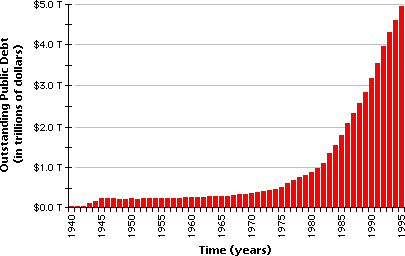
The National Debt is the total amount of money owed by the government; the
federal budget deficit is the yearly amount by which spending exceeds
revenue. You can't necessarily tie the two together -- that is, the
government doesn't provide the excess money overspent by exceeding the
deficit with more debt. This would be analogous to your spending more
money than you have in your checking account. You don't take out a
loan to cover the overdraft; most people typically just stop spending
money and let their income (paycheck) refill the checking account.
What's a "national debt?"
The national debt is the money owed by the government to people who
loan it money to operate. The government typically issues bonds (T-Bills,
or treasury bills), which pay the bondholders interest on their money.
Why does it borrow money? To pay for things it needs or wants,
but they don't have the money. (We'll get back to this.)
How big is the debt?
The national debt is getting bigger, and the numbers look scary:
$5,359,751,371,000 -- over $5 TRILLION. The estimated population
of the United States is 266,886,352, so each citizen's share
of this debt is $20,082.50.
Most people look at these numbers and say, "WOW" and get really upset.
But, there's another side to this, and it's not talked about very much
because the issue gets complicated. The question is, "why is it bad?"
Big numbers and the notion that the US has debt seems bad, but why?
How bad is it? And what does all this moeny we're borrowing pay for?
Is the concept of owing money bad?
First, let's look at the debt itself. Most people carry some kind
of debt. Consider buying a home. What kind of mortgage can you afford?
Ultimately, it comes down to how much income you have and the amount
of the monthly payments for a mortgage. We can't assume people can
buy homes for all cash-- if so, no one would ever buy homes (and our
entire economy would probably fall apart completely). While we want
people to be able to buy homes, we also want to make sure the homes
are worth it. (Otherwise, the assets behind the debt aren't worth it.)
So, the debt should be evaluated on two things: 1) our ability
to pay the debt, and 2) what we're buying with the money.
What's an acceptable amount of debt?
Most banks out here in California (where I live) won't give you a loan
on a house unless your mortage payment is 1/3 your take-home income --
about 30% of your income goes to the mortgage payment of your home.
For those who qualify, they can leverage their "buying power", by using
their job income to make the mortgage payments.
Here, they own assets they would not otherwise be able to have. This not
only makes the quality of living better for most Americans, but also is
a great part of our economy.
Now let's look at the government. How much is an appropriate amount
of debt to carry in order for it to invest in our own standard of
living, which improves our economy? That's the question. Currently,
as high as our debt is, it's only 3.5% of our gross national product
(GNP). In terms of "house-hold income," this would be your take-home pay.
So, our national debt's ratio to our gross national product is like
taking a loan for a house that costs $100K, and your income is $200K.
(This formula assumes your loan is at 7%, or $7K, and that $7K in
mortgage payments is 3.5% of your total annual income.)
Is the debt affordable?
What the American people have to think about is whether having debt
be 3.5% of GNP is a comfortable number.
My personal opinion is that anyone with a $200K
annual income is in an extremely "safe" position to make payments
of $7K/year. What's more, if the benefit of having purchased the
home is a better economy through more jobs, production of materials,
and other side effects, I think we're in great shape.
But, here's the real issue: if I'm going to loan someone money, even
if they can afford it, I want to make sure they're spending it wisely.
What's the debt paying for?
As I mentioned before, if you were going to loan money to someone to
buy a house, you want to make sure it's a good house -- not a shack.
In general, what is money our debt being used to do?
The government spends a good deal of money on varous things from research,
health, education, the military, agencies, and public entitlements.
These include welfare, social security, medicare, and other benefits that
Americans can qualify for under certain conditions. There are those
that think this is a bad idea -- they call them handouts. There are
others that think these benefits are what improves our standard of
living, and helps improve our society and culture. (There are even
sociologists who argue that such programs are less costly than not
having them, since we would otherwise spend more money increasing
police forces and other programs to deal with crime, drug abuse, etc.
These arguments have advocates on both sides of the issue.)
Before the government had any debt at all -- in fact, it used to have
a surplus -- the government had no social programs at all. Nor did it
have education programs, like student loans or public higher education
itself (universities); it had no agencies, such as the FBI, FCC, FAA,
or CIA; we gave no aid to foreign countries, through which we can
benefit from their economies buying our products from our country.
There's a lot going on here, and there's a lot to think about.
You may or may not want entitlements, foreign aid, health or education
programs ... but those are the issues we need to consider
strongly, not the simple fact that we have a national debt that's $5
trillon.
So, in closing, my feeling is that concern about the national debt
in and of itself is misdirected. The ratio of debt to the GNP is
not unreasonable. Most economists believe that it has not adversely
affected interest rates, the dollar, or our position in the gloabl
economy, which are more important in the big picture. Tax rates are
affected by the debt, but how much taxes we should pay is a different
issue and should be addressed separately: taxes are directly related
to the second point of the national debt: What do we want to spend money on?
My opnion
I feel we need social security, medicare, and welfare. However, I
feel we should provide incentives for people to get off welfare
(and for businesses to help in that area), that we should improve
on the processes and procedures employed by the medical community
to reduce the cost of medicare, and that the social security program
be "economically optimized" to make it more affordable to provide
financial assitence to those who need it. (For example, the money
in the program is not earning what it could, which would decrease
the rate at which it needs to be filled.)
Some say that if you're not an economist,
chances are your opinions on whether the debt is too high or not
are unfounded. For that matter, experts who do understand
economics are still in dispute about the issue. There are solutions
to these problems, but over-simplistic doctrines pontificated by both
the republican and demoncratic parties will never contribute to those
solutions. Only bi-partisan ideas will move us in the right direction.