INTRODUCTION
“Horses for courses”
Old English saying
The goal of all engineering efforts is optimized systems. In
a few rare cases, engineers are presented with a sufficiently “blank sheet” to
allow wide and fundamental choices in design.
These cases represent the greatest challenges in engineering. The San Francisco Bay Area is currently
involved in just such a challenge, developing a comprehensive ferry system
under the aegis of the Water Transit Authority (WTA), which in turn was created
by the California State Legislature (1999).
The WTA is taking a uniquely holistic approach to the
process, considering intermodal issues, terminal and vessel design,
environmental issues and community impact for an entire system, rather than the
traditional piecemeal, route by route approach. In this process, the WTA has sought input from a wide range of
stakeholders
The enabling legislation has also emphasized the importance
of new technologies. The authors are
therefore taking this opportunity as a forum to offer some of their thoughts on
the interaction of vessel and system design, and especially some interesting
developments that may be viable in the long term.
The one overriding issue the authors came to understand during
the development of this paper is the diversity of options, their complex
interaction and thus the need for very careful and detailed analysis of every
option. This is not a simple task and
the authors commend the WTA staff for taking it on.
BACKGROUND
A comprehensive modern urban ferry system encompasses many
disciplines and complex interactions of systems. Unlike most new ships, a whole new system has very little
“givens’ or existing interfaces to fit into.
There are also competing measures of effectiveness, so there is no
simple optimizing function analogous to required freight rate. For example, the first question a ferry
designer must answer is whether water transport is justified at all.
In urban areas with un-bridged water barriers this question
is moot. However, San Francisco has a rail transit tunnel and numerous highway
bridges spanning all the major arms of the Bay. Water is very sticky stuff, and
the small fast ferries most desirable for maximum regional mobility are
inherently inefficient. So it is easy to show that rail or road transportation
is far more efficient when the infrastructure already covers the intended
routes.
Despite these resources, urban areas with water barriers are
finding ferry transportation increasingly attractive. This is arguably due to
the lack of political will to manage the bridges and tunnels efficiently. So
the reality, even though it may be artificially imposed by poor transportation
planning, is that a body of water with a bridge above it and a tunnel below has
once again become a very real barrier to mobility.
Whether a ferry service is the best way to improve mobility
across the water barrier is an issue bound in politics and economics: Those who
benefit from a public work should pay for it; those who pay for it should
benefit, at least indirectly. This is
especially important for modern urban ferries, as it is rare that a ferry (or
any other mass transit system) will cover its operating cost out of the
farebox. Thus, non-riders subsidize
riders through bridge tolls or taxes.
Minimizing the level of subsidy increases even more the need for
optimized solutions. However, even if
full farebox cost recovery is possible, non-riders “pay” through environmental
impacts, loss of waterfront and effects on growth. Even if a free, perfectly benign transport system could be
invented, it would reduce the disincentives to growth caused by difficult
commutes.
A ferry system is also an intermodal system: There are
tradeoffs between waterborne and landborne portions of the overall system, as
well as interfaces between existing land systems and new ones.
On the other hand, modern urban ferries that parallel bridge
and tunnel crossings have some unique features, which lead to opportunities for
unique design solutions:
·
Routes are
very short
·
Variation
between minimum and maximum load is relatively small
·
Extensive
support can be made available at a terminal.
·
Vessels
operate at one speed only.
·
Vessels
can be optimized for a particular route.
The San Francisco Bay Area also has some unique
characteristics for ferry design:
·
Weather is
relatively mild and consistent.
·
Water
depth is less restrictive than in other estuaries.
·
Most ferry
runs are reasonably sheltered from waves, so seakeeping is not of great
concern.
·
Though of
concern in some key areas, few runs have great sensitivity to wake.
·
Property
in general, but especially waterfront property, is vastly more precious than in
many other areas.
·
The public
is very sensitive to environmental issues.
PASSENGER CAPACITY AND VESSEL SIZE
“For who hath despised the day of small things”
Zechariah 4:10
There is an important difference between ferries and other
urban transport systems. Classical
urban transport theory holds that though more small vehicles are often more
convenient than a few large ones, but if the vehicle can be filled; the largest
possible vehicle is always best (Vuchic, 1981). Put simply, this is because personnel costs and the costs of and
access to right-of-way (rails, tunnels, restricted lanes, etc.) are not
strongly connected to vehicle size, but to vehicle numbers. Many small vehicles require considerable
right-of-way length because of the requirement to allow headway between them,
and additional provisions to allow moving vehicles to pass stopped ones. (This is, of course, the basic problem of
automobile traffic.) Thus overall
passenger productivity of the system, both with respect to cost and with
respect to passenger capacity always rises with vehicle size.
This effect is not nearly as powerful for waterborne
craft. First, there is no right-of-way
infrastructure, and within fairly broad limits, watercraft can wander about
freely. Second, Coast Guard regulations
link crewing requirements to number of passengers per craft. The guidelines provide for a master plus one
hand for each deck, plus one more hand for varying numbers of passengers over
149. A 299-passenger ferry will require
a minimum of three total crew on board, (if all 299 passengers are on one deck)
whereas a 149 passenger craft will only require two total crew.
Third, the distinction between a small passenger vessel and
a ship is based on exceeding 100 gross tons, which is internal volume
“admeasured” in a very specific way.
The natural point at which a vessel might exceed 100 gross tons is near the
size of most practical ferries, and operating a typical urban passenger only
ferry larger than 100 gross tons is probably economically unrealistic.
Though it is possible to use various aspects of the
customary US admeasurement rules to advantage so as to make quite a large
vessel less than 100 gross tons, there are costs, increases in weight, and
distortions in design required to achieve this in large craft. The typical
strategy is to exclude the superstructure of the vessel by use of tonnage
openings and minimize the admeasured volume of the hull by excessively deep
frames. (Volume outboard of the inner
faces of the frames can be excluded under certain conditions.) This adds weight and cost due to the frames
and frequently requires increased shell thickness to allow greater frame
spacing. Experienced designers of small
ships remark that tonnage concerns can add anywhere from 15% to 25% to the
total weight of hull structure. This
also favors designs that have relatively large superstructures as compared to
their hulls, which gives advantage to catamarans. (However, the Coast Guard accepted comments for a proposed change
in the basic tonnage breaks scheme in 1998, with the intent of using
international conventions that do not have the peculiarities of the US
system. Substantial changes in tonnage
that will eliminate the distortions required now may be seen soon.)
Fourth, there is a significant step function in Coast Guard
vessel safety criteria at 49 and much more so at 149 passengers. The latter is the break between subchapter T
and subchapter K of 46 CFR. “T-Boats”
are more or less boats, whereas “K-Boats” are in many respects ships, at least
with respect to most engineering systems.
Probably even more important is structural fire protection. Subchapter K requires that vessel structure
offers fire resistance “equivalent to steel” and imposes complex regulations on
fire protection subdivisions. These
latter requirements limit use of materials, the sizes of spaces, control
interconnections between them for mechanical systems (especially HVAC), and
often require substantial insulation on required fire resistance
boundaries. This is especially
important for high-speed craft or other craft which have to be light because
composite (GRP) construction is virtually forbidden and aluminum structure has
to be insulated from fire effects, since it loses strength at relatively low
temperatures. This latter requirement
not only adds cost, but weight. Some of
the weight advantage of light alloy construction is lost due to the additional
insulation it requires: a weight penalty as high as one and one half pounds per
square foot is common. Since high
strength low alloy steel superstructure might run only three pounds per square
foot heavier than a comparable aluminum structure, half the weight advantage of
aluminum is lost.
And fifth, turn-around time at the terminal has a very
strong affect on actual trip time. For the relatively short routes under
consideration, shaving a few minutes off the loading and unloading time can be
as effective as increasing speed by several knots. This can more than make up
for the fuel efficiency advantage associated with larger vessels. The result is
that a smaller ferry with quick turn-around, operating at a lower speed, might
deliver the same service as a larger ferry going faster, but with less fuel
burned per passenger-mile.
Each of these topics is a complex one, and numerous papers
have been written on each of them, so the authors won’t belabor them too much
further. However, in very rough terms
of the impact of these issues on cost, it is worth remarking that one of the
authors designed and built a 25-knot, 49-passenger aluminum ferry in 1992 for
$160,000, or $3,265 per passenger. The
same shipyard had previously built a number of 149 passenger ferries in the
same speed range for less than $750,000 each, adjusted to current dollars
($5,000 per passenger). However, recent
larger fast passenger catamarans have cost $10,000 to $20,000 per passenger or
more. Though not all of this cost
differential is due to size, much of it is.
Ferry planners are urged to evaluate very carefully the impact of vessel
size and passenger capacity on cost, especially as regards to exceeding 149
passengers.
POLITICS
“Money is the mother’s milk of politics”
Political opposition to a ferry system primarily stem from
economic and environmental concerns: First the economic: The main concern is
that some small group will be subsidized by other “more deserving” groups.
Since ferries are frequently more expensive (even with
farebox subsidy) than other modes, this is sometime cast as poor bus and car
riders paying for wealthy ferry riders.
However, buses and other land modes are also subsidized, perhaps even
more. Automobile drivers who “pay” the
subsidies in the form of gas taxes and bridge tolls can be particularly
aggrieved, but they should realize that there is a structure of subsidies on
automobile travel so pervasive as to be invisible. In the Bay Area, transit subsidies also come from sales taxes,
which are regressive in their effect, so the claim that the poor are bearing an
unfair load has some credence. A ferry
system must therefore have, and be shown to have, benefits that flow to
non-riders, including those who don’t use transit or even commute long
distances at all.
It is relatively easy to perform this type of analysis for
automobile traffic. The current ferry
system operating between Marin County and San Francisco is the equivalent of
one bridge lane, and is certainly less expensive. Studies by Shrank and Lomax
(2001) place the annualized cost of traffic congestion at $2,805,000 in
the Bay Area in 1998 for 162,830,000 daily vehicle miles traveled and $3,055,000
in 1999 for 168,880,000 daily vehicle miles traveled without any change in
available lane miles. The difference in
cost divided by the difference in daily vehicle miles suggests that the
increment value of taking a vehicle off the road each day for a mile is $41 per
year. If every 1.5 ferry riders takes a
car off the road every day, for the round trip from Berkeley to San Francisco
ferry transport is worth about $0.23 per mile of the land distance between
terminals just to reduce traffic congestion.
For transit riders, the question is even simpler, because
there is a direct comparison between the costs of service. Valley
Transportation Authority (McGregor, 2001) submitted a proposal for a Regional
Express Bus Improvement Plan with a cost per rider of $6.90. In fiscal 2001, farebox recovery was 13%,
(sales tax provided 53.6%). The bus
subsidy for this proposed service is thus on the order of $6.00 per
passenger. As another item of
comparison, a new articulated bus has a peak capacity (225% of seated capacity)
of 145 passengers, costs $500,000 and has an average system wide speed of 14
(statute) miles per hour. A “bare
bones” 149 passenger ferry could probably match this speed for the price,
with all passengers seated. (However, manning costs would be higher:
Coast Guard regulations require an operator and a deckhand for this size
craft.)
Current ferry subsidies range from $6.33 for the Larkspur
ferry to $1.09 (1997) for the Alameda/Oakland ferry, with rates per passenger
mile of $1.15 (Alameda / Harbor Bay, 1998) to $0.16 (Vallejo, 1998). These subsidies are at reasonable levels
both based on parity to other transit systems and by evaluation of the value of
decreased congestion. (Note also that
this is based on sea miles, not replaced land miles.) If a ferry service is feasible at these levels of subsidy, it is
politically acceptable on an economic equity basis.
Ferries can also be used as a tool to develop the political
will to manage bridges more sensibly. For example, initiation of a ferry
service with capacity equivalent to one bridge lane has been proposed as a
rationale for converting one lane of the Bay Bridge to bus and HOV only. While
this would not directly reduce congestion for single-occupancy vehicles, it
would significantly improve bus mobility and increase the incentive to carpool.
For the poor, or retired persons who rarely use transit but
still pay sales taxes, the question is whether the increased economic activity
associated with a ferry benefits them, either by affording them jobs or by
allowing others increased income, which can then be taxed to support their
benefits. It may be true that a ferry
will increase the productivity of workers using it, but it would probably be
difficult to prove.
However, if ferries were built and maintained in the Bay
Area, this would clearly provide local blue-collar employment. It is difficult to estimate this effect
accurately without knowing how many ferries and routes will be eventually
needed but a simple calculation is possible.
A number of about six billion dollars for the complete system has been
thrown around at various points. This
represents about half land construction and the other half shipbuilding. The land construction portion is clearly
substantial labor, and a substantial job base, but these authors will leave
that part to others to estimate. The
marine portion would be three billion dollars.
A typical shipyard worker building small aluminum vessels generates
about $100,000 to 150,000 of final vessel price per year, comprising his wages,
profit and overhead, and the value of the materials he installs. The three billion dollars thus represents
20,000 man-years of direct labor, two thousand new jobs for a ten-year system
build out. The two thousand jobs are
also positions directly “hanging steel”.
The factor used assumes that engineering, purchasing and administrative
jobs are overhead, so there would be another 200 to 400 “white collar” jobs,
and other ongoing jobs to maintain the fleet, both trade and
administrative. With economic
multipliers on the order of ten or so, a ferry system could be responsible for
twenty-five thousand new jobs.
Of course the question is whether this is new activity or
activity shifted from some other sector, and thus no net gain. Clearly, there would be some substitution
effect; construction of freeway or rail right of way would result in many jobs,
but it is unlikely that it would be feasible to begin new bus, railcar or
automobile manufacture in the Bay Area, and much of the cost of right of way is
land, which is probably zero sum with regard to jobs. The additional fuel used by cars idling in traffic is also a dead
loss to the area. Vessel financing,
farebox recovery and possibly federal grants also leverage the cost of ferry
construction.
For a system operating at a lower subsidy level with higher
ticket prices, novel means of deflecting political opposition due to the
perception of elitism have been proposed. One plan suggests giving bicycle
riders deep discounts or even free passage, analogous to the free passage over
toll bridges now offered to carpools during commute hours (Ebb, 2001).
On balance, it seems clear that some level of ferry activity
is justified, that a reasonable level of subsidy is justified, and that
especially if some ferry construction is undertaken in the Bay Area, most
sectors can economically benefit from a ferry system and should be willing to
support it politically.
ENVIRONMENTAL ISSUES
“It’s not easy being green”
Kermit the Frog
The main potential environmental impacts of ferries are air
pollution due to engine emissions, wake, water pollution from bottom paint,
loss of waterfront, noise, and effects on growth, particularly locally to the
terminal. There are also minor
potential effects from industrial activities to maintain the vessels, but these
can be mitigated by current practices.
It is important to note that the effects (except for wake) may not be
entirely or even mostly due to the vessel itself. The intermodal connections may cause environmental impacts as
well, especially if large numbers of automobiles are involved. It is in the mitigation of environmental
effects that new technology and other systems have the most potential to make a
ferry system the best possible ecological choice.
First, it is important to remember that minimizing or even
evaluating environmental impacts is rarely as simple as it seems. A good example is use of “biodiesel”, which
is derived from plant oils, usually soybeans.
This fuel is said to reduce particulates, and other adverse effects of
conventional fossil fuels. It also
reduces greenhouse gases in that it recycles carbon through plants rather than
releasing it from deep in the earth.
However, though biodiesel is partly derived from “used” oils, these oils
are not really waste. They are
currently being recycled for other uses such as cosmetics, paints and animal
feeds, so diversion of this stream to fuel will require replacement to fulfill
current needs.
Extensive use of biodiesel will require increased farming of
oil seed crops, which has environmental impacts of its own, most notably
increased water pollution. Though
soybeans are nitrogen fixing, they still require phosphate fertilizers, which
run off and increase nutrient loads in rivers and estuaries. The increased mass of agricultural waste
(soybean, traditionally, is plowed under to add nitrogen for a successive
non-legume crop) may also increase greenhouse effects: Rotting vegetation produces methane, which
has twenty times the greenhouse effect of carbon dioxide. Economic input (money for fuels going to
farmers instead of foreign oil producers) may also have environmental effects.
Extensive use of biodiesel may require further remediation measures, such as
collection and utilization of agricultural waste, growing filtering species
such as sawgrass in agricultural runoff areas or artificial aeration of rivers
or estuaries. Each of these
technologies has impacts and opportunities as well: Sawgrass has been proposed
as a feedstock for other biological fuels (Blankenship, 2001).
The recent report by Long (1999) is another example. This report oversimplified the analysis,
“spun” some data, and neglected critical information and thus greatly
overestimated the relative air pollution produced by ferries as opposed to
automobiles and buses. Sweeney (2000)
has offered a more accurate analysis that shows that the basic conclusion of
Long was backwards; ferry transit produces less air pollution than auto
traffic, though perhaps slightly more than bus traffic, and this did not even
consider the potential of each ferry rider to eliminate 26 gallons of fuel per
annum wasted idling in traffic, or the fact that new ferries can no longer use
the uncontrolled engines considered by the Long study. Thus the Long report, intended to defend the
environment actually advocates actions that increase environmental degradation.
Even accurately evaluating, much less minimizing
environmental impact requires careful evaluation, with great potential for
surprises. Good science is important
and flawed environmental science is harmful in a similar fashion to medical
quackery; both delay appropriate treatment and allow the patient to be harmed
meanwhile. Regardless of the flawed
nature of the Long study, though, it has had an effect of bringing the marine
industry to “flank bell” with regard to alternative propulsion and other
measures to minimize air pollution, so it is not a total loss. For example, Ecosound has in production a
system comprising a special wet exhaust system with a water separator. The water is subsequently filtered and the
HC and particulates are removed (Fulk, 2001).
Wake wash is another issue that requires careful
evaluation. Most of the major impacts
(literally) of wake wash have been seen in Europe, where a fast ferry might be
a 100 meter long vessel with several hundred passengers and a couple of hundred
cars and trucks, doing 36 knots. This
is a very different creature than what is contemplated for the Bay Area. There are wake sensitive areas in the Bay
Area on ferry routes, but the sensitivity and tradeoffs for such areas needs to
be carefully evaluated. Blume (2001)
has discussed the work of the International Navigation Association’s (PIANC)
Working Group 41 to develop guidelines for managing wake wash and notes that
wash is highly dependent on channel conditions and their interaction with
vessel characteristics and speed.
Effective management of wash also requires an understanding of how wash
creates risk in a specific site for property damage, to persons on the
shoreline, and to the environment. The
working group therefore is developing guidelines for a careful, site specific,
risk based evaluation process for wash effects rather than generic
standards. The guidelines will be
completed in 2002.
Non-toxic low surface energy slick coatings have recently
been developed that self clean by the effect of the boat’s motion through the
water. These coatings don’t work very
well in environments subject to heavy fouling (such as the Deep South), are
readily damaged by ice, and require that the boat be relatively fast and
operated frequently. Fortunately the Bay is relatively mild with respect to
fouling and does not ice, and even slow ferries are fast enough and don’t sit
idle for very long. Operators in the
Bay Area can readily find environmentally benign bottom coatings.
A certain amount of waterfront loss is inevitable for a
ferry terminal, but this too can be minimized.
Likewise, good strategies for effective intermodal connections can
minimize local effects, and the whole point of a ferry is to minimize regional
effects. One strategy for minimizing
perceived waterfront loss is to use mainly floating terminals. The Sea Bus system in Vancouver’s Burrard
Inlet uses entirely floating facilities made of concrete, though in this case
to deal with a 17-foot tidal range.
However, the terminals are expected to have at least a 50-year life,
Case (1981). Terminals in sensitive
areas could also be placed well away from shore, connected by floating or cable
suspended walkways (since weather that might deter a fifty yard walk is
relatively rare).
An even more interesting possibility for mitigating the
impact of both terminals and wake is a revival of the oldest ferry
technology: The terminal itself could
move out to the ferry by hauling itself on an underwater cable.
A properly planned ferry system can be a ecologically
effective, and may give important opportunities for applications beyond just
ferries.
ATTRACTING RIDERS
“If you build it, they will come”
Field of Dreams
Unfortunately, this is not really true. Traditionally a ferry is in a pretty strong
competitive position because it is usually the only alternative to
swimming. However, in the Bay Area,
ferries have lots of competition from other modes, so a ferry system must offer
a higher level of service, as considered by enough riders to make the system
viable, than other modes. Level of
service is the overall measure of all service factors that affect users and
includes speed, price, amenities, convenience and comfort, both on the vehicle
itself and in the terminals. The
perceived level of service, and what factors make it up also varies strongly
from rider to rider according to both practical and emotional needs.
Speed beyond about twelve knots or so increases costs
rapidly for waterborne transit in this size range, so the lowest acceptable
speed will almost always be the least expensive (and have the least
environmental effects, and so on).
However, if the overall trip time for a ferry is much larger than that
for competitive modes, it will be a perceived reduction in level of service and
may affect ridership. Simple
calculations can compare ferry routes to the land alternatives. Note that trip time must also consider
various delays. The delay is the time
spent waiting for the ferry, getting aboard, waiting for it to untie and
maneuver at low speed and similar events on the arrival side. Assume the
competing mode is BART, from downtown Berkeley to Embarcadero: With a five-minute delay, a 19-knot ferry
beats BART even if the rider happens to step into a BART platform just as the
train opens its doors, and if the rider arrives on the platform to see a train
accelerating away, a 19-knot ferry is competitive even with a twenty-minute
delay. Assume the competing mode is
auto, vanpool or bus travel based on mean speed from Shrank and Lomax
(2001). A Vallejo / Marin commute shows
a competitive speed range of 22 to 28 knots and a competitive speed of 30 to 38
knots is required for a Vallejo to San Francisco route, depending on
delay. In each case, the role of reducing
the delay in reducing the required speed is substantial, so efforts to reduce
loading time, maneuver time, and connection time may be more profitable than
efforts to increase speed. Again, the Sea Bus is an excellent example of a
system where loading and maneuver times were carefully minimized, achieving an
amazing 40 second loading period for 400 passengers. (This system is also very highly optimized to its intermodal
connection and the reference is highly recommended in general for ferry
planners.)
The waiting time depends on three factors; the time between
ferries, schedule reliability and the probable variance in connection time to
the ferry terminal. This last factor is
more important than the actual time itself. Riders will generally, (though
unconsciously), regard the probable time of arrival at the terminal as that
which is within two standard deviations of the average. Informal surveys of transit times involving
the difficult Washington DC Beltway by one of the authors suggest that there,
the two deviation commute is within five minutes even for very long times. If this variance is typical, a ferry rider
will time the connection to wait five minutes or less. If the variation is larger, riders will allow
more time for delays getting to the terminal, and thus wait longer. However, the wait is also limited to the
maximum time between ferries. This
tends to favor more, smaller vessels, leaving frequently, so surveys of
connection time variance are an important part of planning a system. This is also true for other modes, but the overwhelming
economy of high capacity vehicles for land modes makes such a course of action
very unfavorable, (Vuchic 1999).
The convenience of a ferry system will always be a
significant liability. Very few riders
live next to a terminal, so there will always be at least one transfer between
modes for a ferry trip. Good intermodal connections are thus critical to
successful ferry systems. A rule of
thumb is that each transfer deters fifty percent of users. It is difficult to imagine many riders
tolerating more than one transfer between home and arrival at the
terminal. The authorizing legislation
enables the WTA to operate buses as necessary to provide connections and the
design of this support service will be as vital as any other component of the
overall system. However, the authors
feel that this element is so critical that new, innovative measures are
required in addition.
Cost is another element of level of service. The ticket price for the Berkeley –
Embarcadero center trip is $2.75 one way, which would probably be difficult to
match in a ferry without substantial subsidy, so other aspects of level of
service as perceived by the riders will have to be higher.
Comfort is another element of level of service, and is an
advantage of ferries, especially in the relatively benign sea states in the
Bay. Note here that as long as tonnage
limits aren’t pressed too hard, length is an advantage for watercraft and
relatively inexpensive, perhaps even producing substantial resistance
reduction. This reduces both first
cost, (steel is generally cheaper than engines) and operating cost, through
reduced fuel use and engine maintenance (just overhaul cost on a diesel for a
fast military patrol craft can add as much 50 dollars to each hour of
operation). This means that space and
especially open deck space is relatively inexpensive.
Thus, ferries can be long and spacious, and few vessels
would be small enough to cause seasickness for most riders. Noise and vibration can generally be better
controlled on a boat than on other modes.
There are some issues to be careful of though: Some people are very
sensitive to diesel odors, which may occur on open decks in following
winds. (Buses often also smell, but
don’t usually have open decks.)
Arrangements also require thought; recent British Columbia fast ferries
were widely criticized for a seating arrangement based on groups of four, which
tended to leave inadequate seating when used by smaller groups.
Ferries also can offer amenities unfeasible on other modes,
(including, of course, a pleasant boat ride) again because of space, and
because of open deck areas. Even if
food service is not provided aboard, most ferries can allow people to bring
food, can enable snack service at or near the terminal, and can provide space
and quiet to consume food. Restrooms
are required on ferries, and on the Seattle ferries are very important for
riders preparing for work. A joke is
that the hair dryer outlets consume more power than main propulsion in the
morning. Open deck space (and benign
weather) can allow riders to bring bicycles or companion animals, which are
important issues for some riders. (Readers may suspect “dog-friendliness” is
important to the authors). Amenities
also extend to terminal design and features including security and comfort
features as well as the opportunity to buy a latte.
The key problem is to determine those features that
contribute to a high enough level of service to attract sufficient patrons,
which may produce surprises. For
example, some ferry riders prefer a slower ride as it allows enough time to
read the paper or finish a snack.
(There is a legend that the lengths of New Yorker articles are
optimized for the Long Island Railroad commute into Manhattan.) One way that this can be determined a priori
is to conduct extensive surveys, and the WTA is engaged in this now. However, in addition to the cautions normal
for surveys, Hockenberger (2001) offers some cautions specifically to ferry
planners, most notably that responses to polls aren’t commitments and aren’t
based on real world experience by those polled. The authors would like to offer an additional amplification on
one of Hockeberger’s comments: Ferry
travel is perceived as fun and pleasant, especially by its enthusiasts and
those not using it every day, but for most travelers, transport of any kind is
a means to an end, a “pain in the rear” to quote exactly, in the long run. Travelers eventually decide on modes based
more on disutility, negative factors, than positive ones. Ferris have some probable disutilities,
including cost, the inconvenience of connections and probably time. Planners need to work on minimizing
negatives and to account for this sort of “honeymoon effect” in their polls.
The authors would like to suggest actual experiments with
real ferry riders to investigate true effects of delays, speed and so on. Riders could be offered reduced fares to
participate in various types of experiments, especially involving intermodal
connections and then be interviewed in focus groups. Experimental psychologists are very good at devising means of
deceiving subjects and “messing with their heads” to get to the truth in these
sorts of studies.
INTERMODAL CONNECTIONS
“Getting there is half the fun”
Old ad slogan for travel
As many sources have pointed out, most recently
Hockenberger, (1996), a ferry is part of a chain of transport. The profound effect of both delays and the
disincentives of transfers mean that ferry planners must make intermodal
connections a key focal point. Fortunately,
ferries also provide a unique feature that simplifies intermodal issues. A ferry terminal is a destination that
splits a transport system into two parts, one on each side of the water. The intermodal connections are two each
“many to one” systems, and are orders of magnitude less complex than a “many to
many” general urban system.
The most obvious effect of this is to increase radically the
feasibility of paratransit, especially carpools. A carpool or (a public paratransit system like Supershuttle) is
only feasible if the users share either a destination or an origin. Thus carpools generally are workplace based
with members of each pool living somewhat near each other but having a nearly
common destination. A ferry terminal is
such a common destination, and people with quite different final destinations
(especially if ferries depart the same terminal for different end ports) can
easily carpool together. All that is
required it that the ferry operators facilitate carpooling by strategies as simple
as rideshare boards, or preferential parking.
With two income earners going to different destinations as well, “kiss
and ride” carpools might even allow some non-parking carpools. The success of single destination
paratransit systems like Supershuttle suggests that such jitney services would
be economically feasible for a ferry as well, and at lower rates, since vans
could be reliably filled every day and commuters could be charged by the
month. (Such a system operates now
between Annapolis, Maryland and several
federal agency headquarters in Washington, DC.) Again, it would be relatively easy for a ferry operator to
facilitate such systems. At the
destination terminal, company sponsored paratransit is effective as well, and
terminal pickup vans have been running for decades in conjunction with many
public transit systems. Again, a ferry
operator can facilitate such connections very easily by dedicated access lanes.
Since one environmental objection to ferries is the impact
of parking and traffic at the terminal site, another obvious solution based on
“many to one” is multiple remote “park and ride” (and ride) sites served by a
dedicated bus feeder. This adds a
transfer, which is a disincentive. The
authors would like to introduce here the notion of the “strength or weakness”
of a transfer. The deterrent effect of
a transfer depends on how perceptible it is and this deterrence can be
minimized. After all, most people do
not avoid changing modes to ride in an elevator, and some airports have light
rail systems connecting terminals.
Minimizing the strength of a transfer can involve psychological means
such as common color schemes and practical matters such as combined ticketing
at the first mode and careful scheduling.
If a park and ride bus always arrives at the ferry when it is ready to
board, a wait for the ferry to leave will not be perceived as anywhere near the
inconvenience of arriving at an empty quay and waiting for the ferry, even if
the real time between leaving the bus and the ferry departure is the same. Good thinking about the connection between
bus and ferry, plus the ability of the operator to coordinate in real time
between ferry and bus if needed may reduce the impact of the transfer, especially
if terminal “mechanics”, such as ticket purchase, can be taken care of at the
park and ride lot or aboard the bus.
(Obviously, the bus could also serve foot passengers as part of the park
and ride loop.)
The pain of transfers can also be reduced by
technology. Studies performed by the WTA
suggest that making them more predictable, through such techniques as real time
information on schedules at stations and over the Web can mitigate the
disincentive of intermodal connections, and such techniques are reasonably
feasible with current technology. One
scheme would be to connect the stops by low power radio and have them relay
data to each other and to standard wireless devices used by riders nearby to
display a countdown to bus arrival. The
next time readers download a large document from the web, they might consider
how such information can reduce somewhat the discomfort of a wait. It is possible that schedules could even be
optimized in real time by such a system using software based on fuzzy logic.
A more radical option is to encourage the use of “light
urban vehicles” as an intermodal system. LUVs are non-freeway worthy vehicles
including bicycles, hybrid human/electric vehicles and small electric cars
(“neighborhood electric vehicles”, essentially fancy golf carts,) to connect to
the ferry. In 1998 a ruling was handed
down by NHTSA allowing such vehicles on roads posted at speeds less than 35 mph
at local option. In one such plan, the
New York Power Authority, with the Long Island Railroad, is offering commuters
a lease of Ford Think City electric vehicles, preferential parking with
recharging facilities and a discount on the monthly ticket Sharke (2002). The schemes to encourage such vehicles are
endless. Bicycles and single person
hybrids are a no-brainer here – there
is no reason not to allow bikes secure storage at a terminal or even aboard the
boat, but planners need to ensure that terminals are bike-friendly, with
traffic controls to make cyclists safe from other traffic. Required remote parking for non-preferred
cars (not carpools or LUVs) and highly controlled “kiss and ride” lanes would
go a long way toward this by reducing traffic at the terminal.
NEW TECHNOLOGIES
“These are the days of miracle and wonder”
Paul Simon, “The Boy in the Bubble”
New developments often require more than just an effective
technology to be viable. Automobiles
requiring special fuels, for example cannot function without a wide spread
infrastructure of stations offering this fuel, which in turn requires many
automobiles using it, a sort of “chicken and egg” dilemma. The computer operating system wars provide a
real world lesson in this. A ferry
system provides an opportunity to demonstrate and nurture special technologies
because it is relatively self-contained and limited in scope. A ferry system might well just be the
initial catalyst for a more widely applicable technology, and therefore have
effects far beyond just getting people to work. That said though, it is important to realize that a ferry operator
has a fiduciary duty to provide cost effective service. If a ferry is used as a demonstrator for
some new technology with wider benefits, those that benefit should pay, and the
operator should be compensated specifically and explicitly by public sources
(such as state general funds) through earmarked grants for the impact of using
the technology.
Computers themselves are a new technology that enables many
others. Some Computer Aided Engineering
gurus have called this the “Age of Customization”, because CAE/CAD/CAM enables
an integrated environment that affords very rapid and thorough design,
analysis, and prototyping at minimal cost.
Specifically for high-speed craft, Ulak, Akers, et al (2002), have
recently implemented and validated methods for direct computer simulation of
the behavior of high-speed craft in waves, improving optimization and reducing
risk. Another group has developed a
completely new rocket engine in less than a year using only a small team and
desktop software. Home aircraft
builders have used these techniques to build flight qualified (for experimental
aircraft) gas turbine engines in their garages. An engineer with a laptop and a modem can design and model a
system in three dimensions, perform Finite Element Analysis, Computational
Fluid Dynamics, and many other analyses on it and send the model to a rapid
prototyping service. The next morning,
a FedEx package will come with a precise model of the part in plastic. Meanwhile, another vendor is taking the same
model and part, investment casting it in stainless steel and finish machining
it. One of the authors developed a
simple system at a shipyard that used parametric hull and systems models
integrated with speed and power and stability software. Within a week after receiving an order, a
construction design for an aluminum workboat was complete and files to cut all
the aluminum parts were sent on line to a distributor, who delivered them the
next day. There is also much more understanding about “thinking about thinking”
and software tools to aid in this. All
of these techniques enable new solutions and customized designs at much lower
cost and risk than ever before.
ALTERNATIVE FUELS AND PROPULSION
“Row, row, row your boat”
Traditional Round
A number of alternative fuels and propulsion technologies
are being investigated by the WTA. The
authors would like to add something to this, keeping in mind the desirability
of looking at a fuel through its entire cycle.
Gaseous fuels, especially natural gas (mainly methane) are
especially attractive. It is relatively
less polluting than other fuels, both with respect to trace materials like
hydrocarbons and sulfur, but also with respect to carbon dioxide
generation. Geological origin natural
gas is widely available (though not as cheap as it used to be) and may become
more so. However, methane is also
available from biological sources through anaerobic decomposition of plant
materials (and insect materials such as chitin, but this might not be
practical), which is what makes gaseous fuels attractive in the long run.
Biological science and solar energy come together in
charming ways to enable this: There are
numerous species of plants that have little food value but have other
features. Sawgrass, though it grows
well without much fertilizer or water and is a valuable soil stabilizing and
filtering species, for example, has little nutritive value for most
animals. Only animals that are very
good at converting long chain polysaccharides to glucose can live on it. Ruminants, (especially bison, hence the
alternative name “buffalo grass”) have developed a very good system that
provides a comfortable home for microbes that do the actual work. One aspect of this home is agitation and
pulping by the animal chewing its cud, and the other is the warmth provided by
the animal’s body. Agitation and
pulping is relatively easy for machinery and solar energy is very good for
providing low-grade heat that might be ideal for an artificial rumen. Other microbes, though they cannot work with
the long chain molecules, can handle shorter ones. Solar pyrolysis followed by biological action might be another
step. All of these technologies can be
applied to agricultural waste as well.
Though this might require collection systems that would be expensive and
have adverse impacts, it would also reduce methane now entering the atmosphere
from current agriculture practice.
Since methane is a very powerful greenhouse gas, this might be a net
benefit, but again, the whole system needs to be accurately evaluated.
One problem with methane is that it doesn’t work well in
diesel engines. It doesn’t ignite under
pressure and has other drawbacks such as lack of injection pump lubricity. One solution to this is gas turbines, which
are compact, powerful, and have relatively low emissions. Unfortunately, they also have relatively
poor fuel economy and require substantial air intakes.
The Navy explored a solution to this in the '90s, and better
yet, it also reduces NOx emissions.
This is Steam Augmented Gas Turbine, SAGT. This system uses the hot exhaust to fire a boiler. The steam is then injected in the combustor
where it is heated even more. This
lowers the temperature in the turbine, which reduces the efficiency somewhat
but also reduces the thermal load on the turbine blades, so they can be made of
less exotic materials. However, picking
up the waste heat in the gas turbine exhaust lowers the bottom end temperature
of the cycle which is much more effective in increasing thermal efficiency. The big gain though is that mass flow
through the turbine is increased without increasing compressor load, (which is
parasitic on the system) or airflow. As
a result, power produced in LM2500 turbines fitted with this technology was
tripled and fuel consumption for typical DDG 51 service was reduced by almost
30%; Urbach (1994). There are numerous
variants of this technology with various stages of intercooling and reheat, but
it is worth exploring, especially since the lower limit of waste heat recovery
temperature in conventional fuelled engines is based on the condensation
temperature that would produce corrosive sulfur compounds. A methane fuel SAGT plant could “squeeze”
its exhaust even harder for better efficiency.
A ferry is a unique platform for this technology as one drawback to SAGT
aboard a warship is the weight of a reverse osmosis plant to produce the
necessary injection water. A ferry
would not need to carry this equipment – it could take on water as well as
fuel. The technology of RO has also
improved. One of the authors recently
contacted vendors of such equipment and acceptable purity is now achievable in
two pass rather than the three pass systems required a decade ago. One drawback to this system is that the
steam produces a large visible plume, which is a severe problem for a
combatant. A ferry operator would have
to be sure the public knew that the plume was steam, not smoke.
It is also worth noting in passing that more or less
conventional steam is another candidate for gaseous fuels. Since a ferry can take on water frequently,
it can use a once through system, exhausting steam to a direct contact
condenser at very low temperatures.
This also eliminates the steam engineer’s least favorite device, the
deareating feed heater. Feedwater can
be deareated ashore, (possibly with solar heat) in a tower. The turbine can also be simplified. Radial inflow turbines are inexpensive,
simple, very efficient at a single design point (though poor elsewhere), but a
ferry runs at mostly constant power and speed.
To add yet another choice, note that the Navy also has explored gas
turbine heated steam either as additional shaft power or to run the first stage
of air compression; Marron (1981).
Again, on a ferry, this could be very simple as it would be once through.
Another problem of methane is that it is very bulky and the
systems (which have to be at the terminal) to compress it to pressures at which
storage aboard becomes feasible are potentially noisy, expensive and require
energy. The authors have conceptualized
a straw man 149 passenger ferry running 18 knots on two 600 horsepower engines
for a variety of issues. If fueled
twice a day on methane, (at 8 round trips per day) it would need 242 cubic feet
of cylinders at 150 atmospheres. This
is twenty each eight-foot by one-foot cylinders. A comparable liquid fuel rate would be 337 gallons per day,
fuelling once. (And note that liquid
fuel storage can be discounted against tonnage by storing it in tanks with deep
frames, whereas this isn’t practical for cylinders - lightening holes in deep
tonnage frames can’t line up.) Is this
volume of fuel storage practical? Good
question.
Another gaseous fuel is hydrogen. This can be used in turbines, fuel cells, or if pure oxygen is
also available, in a direct steam generator with water injection into the flame. Hydrogen is even worse for storage, (unless
new technology based on absorption in metal powders proves feasible). The straw man ferry requires 34 cylinders. However hydrogen can be produced from solar
energy and it is interesting to imagine a solar powered system to generate it
just to see if it is at all even vaguely possible.
To just get a bound on the feasibility of some kind of solar
power scheme, we explored solar heated magneto hydrodynamic (MHD) power as a
validation exercise. Though ultimately
photovoltaics may be more efficient, the basic physics of MHD is easy to use to
get an estimate. It is the same as any
other heat engine, though instead of spinning a turbine, MHD works by passing a
conductive fluid through a magnetic field.
Most MHD systems use hot gases from burning fossil fuels, generally with
an additive to increase conductivity.
This means that they are essentially a bladeless gas turbine, but they
still have to have a compressor and the resultant losses. However, a solar system can use boiling
mercury instead, since it is highly conductive (thereby eliminating the need
for super conducting magnets – MHD power density increases directly with fluid
conductivity and with magnetic flux density squared).
Liquid mercury is pumped onto a porous heat-absorbing medium
(graphite powder, for example) in a cavity illuminated by a reflector shining
through a high temperature lens. The
mercury boils and the hot vapor expands through a nozzle. The rapidly moving vapor passes through a
magnetic field and electric current is induced in pickups on the nozzle
walls. At the end of the nozzle a
chamber with cooling coils condenses the mercury back to a fluid. This is just a steam engine with a funny
turbine and can be readily analyzed, at least to a back of the envelope level,
by classical thermodynamics, a mercury properties table and just a bit of
magneto hydrodynamics. Something
similar could be done with regular water steam turbines, but MHD (both as
turbine and as pump) allows a sealed system with no moving parts, (except a fan
or water pump to cool the condenser) which is attractive.
The bottom line is that a mercury MHD plant running between
1390 F and 329 F would be able to achieve about 43% overall efficiency or a bit
better. (These calculations are left to
the reader and will appear in the quiz.)
Based on standard figures for sun tracking reflectors at 38 degrees
latitude, the raw solar input is about 3 MW hours per square meter of reflector
per year, yielding about 1.3 MW hours per square meter per year. The same straw man ferry as above, counting
losses due to electrolyzing water, compressing hydrogen, and a fuel cell aboard
will require about 98 reflectors, each five meters in diameter. This would take up a collector field of about
2 acres, or the equivalent area of a parking lot for 270 cars.
Assuming each dish and an allocated portion of the
compression and storage system is $15,000, plus land and maintenance, gives an
energy cost equivalent to diesel fuel at a bit over $3.00 per gallon. With still more shaky assumptions, the
energy cost of a round trip ticket is about two dollars, roughly a dollar more
than a diesel powered craft. Obviously
this cost probably is wrong by a good deal, but it is unlikely to be less. Is this cost differential acceptable? Are there any adverse impacts to planting
these solar dishes filled with mercury steam all over the parking lot? Should society subsidize ferry riders using
solar energy directly? How much? Are the authors totally out in left field
with these analyses? All good questions
which are left to the reader as well, but it does suggest that there may be
something to some kind of solar scheme in the long run, as well as its limits.
HYBRID HYDROFOILS
“Something old, something new, something borrowed…”
Traditional wedding superstition
An obvious way to improve the viability of a ferry system is
to improve the efficiency of the boat itself, especially if a high (hence
costly) speed is required to be competitive with land modes. There are numerous schemes to achieve this,
and many depend on a combination of hydrofoils and planing lift. Hoppe and Migeotte (2001), for example, have
been developing a series of systems comprising catamarans with hydrofoils
between the hulls with substantial success, and several fast craft in
service. The authors have developed a
system, the stepped hybrid hydrofoil, which we initially thought was original
until we sought a patent. We then found
out it had been patented in a basic form in the ‘50s in Sweden and earlier
versions may have seen military service in World War II. Now we have a mystery: Why don’t we see
them now? We now believe that there
were critical issues creating difficulties for the early stepped hull hybrids
and that this is why they are not now 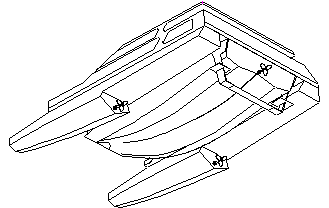 common,
despite their obvious potential. We
also believe that we have solved them, and present our suggestions.
common,
despite their obvious potential. We
also believe that we have solved them, and present our suggestions.
A hybrid hydrofoil is a vehicle combining the dynamic lift
of hydrofoils with a significant amount of lift from some other source, generally
planing lift. The attraction of hybrid
hydrofoils is the desire to meld the advantages of two technologies in an
attempt to gain a synthesis that is better than either one alone. Partially hydrofoil supported hulls mix
hydrofoil support and planing lift. The
most obvious version of this concept is a planing hull with a hydrofoil more or
less under the center of gravity.
Karafiath (1974) studied this concept with a conventional patrol boat
model and a hydrofoil. His studies revealed many configurations were unstable
in pitch. The authors initially became involved with the hybrid concept when
working on FMC’s High Waterspeed Test Bed (HWSTB) for the US Marine Corps,
which was a hybrid with an aft hydrofoil and a forward planing surface. The HWTB project is beyond the scope of this
paper, but the concept worked. A half
scale demonstrator representing a 66,000 lb. armored vehicle made 35 knots true
speed.
Pitch instability is the chief issue in any hybrid hydrofoil
and the variety of schemes are all various innovations to address this
problem. Planing hybrid hydrofoils can
exhibit a dynamic pitch instability similar to porpoising. This phenomenon can be best understood for a
nominal configuration with a single hydrofoil beneath the center of gravity of
a planing hull. If such a configuration
is slightly disturbed bow up from an equilibrium position, the lift on both the
foil and the hull will increase. The
hull accelerates upwards and the intersection of the water surface and the keel
moves aft. This develops a bow down
moment, but at a relatively slow rate.
By the time the bow drops enough to reduce the excess lift, the vessel
is well above the equilibrium position, and the keel/waterline intersection is
well aft. It falls back down toward the
equilibrium position bow down, as if it had tripped on its stern. Then, it carries through equilibrium, takes
a deep dive and springs up again. This
cycle repeats, each time growing more severe.
The only way that this motion can damped is if the hull provides enough
damping to prevent the increasing overshoot.
Note that this is a smooth water instability and occurs with only a
nominal initial disturbance.
The stepped hull concept is obvious from this
discussion. The foil is at the extreme
stern of the vehicle and a step is provided forward of the CG. The step confines the planing lift to the
forward part of the hull so that the relative position of the center of
gravity, the step and the foil control the proportioning of lift between hull
and foil. Bow up pitch of the vehicle
produces a strong bow down moment, directly proportional to pitch, that reduces
the pitch much more rapidly than the movement of the center of planing lift. The step also means that the running
attitude of the planing hull can be set at a trim producing optimum lift.
The authors developed simple programs, discussed in more
detail in Barry and Duffty (1999) to predict the resistance of various hybrid
configurations and found that halving resistance is possible, but so is doubling
it if the parameters are not correctly chosen. A stepped hull hybrid could be a
very bad performer unless computer programs are available to optimize
resistance.
When the bow of a stepped hybrid hull encounters a wave, it
will initially rotate like a planing boat, but the rotation will increase the
angle of attack of the aft foils, which lifts the vehicle bodily upwards from
the rear and reduces pitch acceleration.
The hull is therefore "anticipating" the oncoming wave and
goes over it. This motion has to be
carefully tuned to the anticipated wave environment for optimum performance,
but it is clear that a properly designed stepped hybrid hydrofoil would have
excellent motions, and methods such as those implemented by Akers (1999) can be
extended to partial foil support. Since
good seakeeping behavior is enhanced by high lift in the foil, good motions are
associated with high lift efficiency, and the initial Swedish patent cites
efficient seakeeping as an advantage of concept.
Unfortunately this doesn’t address roll stability, which we
discovered was a problem by experiment.
The lightly loaded forward hull and fully submerged foils provide almost
no roll restoring moment if the hull is optimized for low resistance. The answer to this is a catamaran forward
hull.
We discovered another problem during the HWSTB program: A foil optimized for high speeds would stall
without lifting at the relatively low takeoff speeds. We changed to “barn roof” foil sections, which resist stall to
very high lift coefficients. These
sections were unavailable prior to about 1970, and may be another critical
issue for early hybrids.
Propulsion involves two other problems, especially for pure
hydrofoils: Getting the force into the water often requires passing it through
the struts which is costly in terms of money, appendage drag, complexity and
efficiency. However, unlike a pure
hydrofoil, a hybrid can be propelled by hull-mounted components. However, a hybrid also needs a propulsion
system that will not overload the engine in the takeoff condition. This can be achieved by surface piercing
drives forcibly ventilated by propulsion machinery exhaust or jet drives
mounted in the forward planing hull and discharge at the step. Again these
systems were unavailable to early hybrids.
A final problem is the practical issue of building the
foils. Pure hydrofoils require exotic,
expensive, stainless steel foils. The HWSTB had aluminum foils, but they
required almost 24 hours of machining on a large five axis CNC mill, at
frightening cost. A hybrid is slower
and has larger foils at optimum. These
foils can be made by casting high durometer polyurethane (roller blade wheel
material) in a simple mold over a high strength low alloy steel welded core, so
the foils themselves are affordable.
A ferry is a single speed vehicle, and the hybrid concept is
well suited for this. A route requiring
thirty to forty knots can be achieved at an acceptable level of cost and
reliability with a hybrid. The stepped
hybrid concept is much less dependent on size for speed and seakeeping than a
conventional planing hull, so smaller, less expensive ferries are
feasible. Our concept of a small
passenger ferry is shown in figure 3 above.
Such a craft would be about 75,000 lb. full load and require only about
675 EHP to achieve 35 knots, so a pair of diesel engines in the 700 BHP range
would be sufficient. Such comparison
are always suspect, but about 2000 BHP (total) would be required to propel a
conventional monohull planing craft of the same weight to the same speed. A catamaran of the same weight with two 700
BHP engines would only be able to achieve 26 - 27 knots.
VERY SLENDER VESSELS
You can’t be too thin or too rich.
For those routes (most of them) which benefit from a slower
vessel, another new family of concept is worth exploration; very slender
vessels. These narrow hulls provide
very low drag, especially in the high displacement speed regime needed. They achieve the necessary deck area and
stability by a variety of multiple hull configurations, in some case by as many
as four small hulls acting as “training wheels” (resulting in a
pentamaran). Our straw man concept for
Berkeley is a catamaran, In this case, the low cost per installed horsepower at
engine sizes based on vehicular applications suggests two similar hulls. But
for other sizes, where a single engine and driveline of higher power might be
more economical than two smaller ones, asymmetrical multihulls (proas) have the
potential to outperform the catamaran in terms of cost, resistance, and vessel
motions.
CONSTRUCTION TECHNOLOGY
“Engineers and designers need to gain profound
knowledge of the erection process and incorporate product design and process
design producibility features into the detail design.”
Deming
The final element of ferries in the Bay Area is construction
technology. CAD/CAM has had a major
effect on shipbuilding, especially at small shipyards, which have been in the
forefront of applying CAD/CAM to boat building. The important point of this change is that it enables a new
enterprise to be competitive. In fact
such enterprises, without established bad practices, will be far more agile in
applying new technology and methods.
Barry et al (1998) point out the importance of breaking old practices,
re-engineering whole enterprises and applying lessons from other industries to
small shipbuilding. A start up
enterprise or an enterprise moving from repair to newbuilding can apply these
techniques to start at a point old yards are finally achieving after years of
“broken rice bowls”.
There are any numbers of case histories of radical
improvements to demonstrate the benefits of a holistic approach to
shipbuilding. The author’s shipyard
tripled profits in a single year with a simple CAD/CAM system well integrated
into production and sales. Bender
reduced labor costs by 20% on the first Offshore Supply Vessel that was built
with an integrated system that included outfit, over and above earlier
improvements from automated CNC part cutting.
Eight keys to these radical improvements are critical:
·
Process
re-engineering systematically examines the needs and capabilities of all
members of the organization, and looks for opportunities to change for
improvement, not only in particular processes, but in the interaction of processes.
·
The
integrated product model is the central reservoir of information on the
product. CAD enables construction of
the product model, while process re-engineering develops the conventions of
information in the product model. A
product model must be in 3D and includes non-graphic data and usually links to
other databases.
·
Design for
CAM is incorporating features to improve productivity, and modifying design to
take advantage of Computer Aided Manufacturing. Process re-engineering develops these changes so that they meet
the needs of production.
·
Advanced
outfitting/group technology is finishing whole components as early as possible,
and classifying and organizing tasks by location and type of processes/problems
to plan installation.
·
A flexible
standard product line is building products by using standardized systems,
preferably with parameterized details and standard components and thus
predictable work, cost and process content.
·
Concurrent
engineering is doing design simultaneously across disciplines and includes all
aspects of production as well as the final product.
·
Advanced
workflow control is a variety of techniques to schedule, predict and control
work packages, increasing productivity.
·
Statistical
process measurement and control is the measurement and application of
statistics to the results of all the other processes and changes.
It is worth noting that most of these techniques were
applied during the course of about a year in a small shipyard building aluminum
boats, including small ferries. This shipyard (in a high wage area) had a book
value of about $1,000,000 and turned over $12,500,000 in production the
following year with a profit of about 10%, resulting in an annualized return on
investment of better than 100% up from 30% the prior year. These systems work, are mainly process and
people improvements, not equipment, and can be readily applied anywhere. The importance of re-engineering and being
willing to look at construction processes in a completely new way can’t be over
emphasized. For example, Oetter et al
(2001) have proposed a new technique for building small metal developable
surface ships which might be applicable to fast ferries. This system was actually initiated by TQM
focus groups of shipfitters, welders, riggers and designers and is intended to
facilitate advanced outfitting, which is often difficult in small vessels
because the blocks themselves are too small, components are late and the
engineering effort is too costly.
The proposed system is as follows:
·
All parts
are precut using standard Computer Aided Lofting/Numerically Controlled Cutting
(CAL/NCC) techniques.
·
The boat
is subdivided into blocks, each comprising a major surface, i.e. the port
bottom plate, the port side plate, etc.
Some grand blocks are also designated, mainly the two bottom plates
together, the entire hull below the deck and the entire hull.
·
A jig is
made of angles set up on jackstands for each surface. The angles run along selected rulings of each surface determined
during the lofting process. Other jigs
are built for the deck and other flat surfaces.
·
Other
small jigs can be developed as required for assemblies (such as edge stiffened
webs) to be installed on the surface blocks.
·
The
developed plates are set on the ruling jig, and the longitudinal and transverse
stiffeners are installed.
·
Foundations
and brackets for outfit that will be connected to that surface are installed.
·
The welded
out surface is blasted, primed and optionally finish painted.
·
Outfit
components are mounted on the surface blocks up to limits implied by the need
to lift and tilt the block.
·
The bottom
surfaces are joined to the form the first grand block and all machinery bearing
on the bottom is installed as convenient.
Appropriate parts of the bulkheads can be installed at this point and
subsequently.
·
The sides
are joined to the bottom and appropriate outfit and bulkhead parts are
installed.
·
The
pre-outfitted deck and deckhouses are installed
This system (which is non-proprietary) may be useful, but
more important; it is an example of the type of thinking possible to radically
improve small ship construction through re-engineering.
SYSTEM TOPOLOGY
California Proposition 13, along with other tax and land use
policies, provides a disincentive to residential mobility in the Bay area. This means people do not follow their jobs
as might be the case in other areas so that the commute pattern becomes
increasingly chaotic with time. The
currently proposed topology of the system is a network converging on San
Francisco, which is appropriate for the traditional central business district
commute pattern. This pattern will
probably become less dominant over time, however and may represent an
opportunity for a ferry system. There
are other types of transport topologies including spoke and hub and tangent
loops. (Since San Francisco is nearly
central to the Bay Area, the current system might be considered an informal
spoke and hub system as well.) Spoke
and hub systems imply additional transfers and hence are probably not optimum
for most riders, but may be a critical opportunity for a minority of
riders. Ticketing policies and
schedules can maximize these opportunities for those riders even without a
specific spoke and hub system. Loop
topologies add additional stops for some riders (and longer voyage times) but
not necessarily transfers for all and can serve a wider variety of
destinations. Higher speed vehicles may
be justified for either loop or spoke and hub systems and future technologies
may make them more feasible. However,
one of the advantages of a ferry system is that the system topology can be
changed from voyage to voyage, so the specific long-term topology is of only
minor concern in the planning stages.
Nonetheless, planners should be aware of the need and opportunity to
modify topology in the future.
WHAT WENT WRONG IN SF BAY?
"The trouble with Democracy is that there are
never enough weekday evenings"
Ferries were once the darlings of the environmental
community. The historical reasons for this are fairly clear: Ferries are an
alternative to cars; ferries interface well with public transportation; ferries
interface well with bicycles; and travel by ferry enforces a non-automotive
mode for at least one of the land legs of every trip. Most important of all, ferries
can be far more fuel-efficient and far less polluting than cars. This was
especially true 30 years ago, when ferries were slower and cars were dirtier.
Enter the Bay Area Council's Blue Ribbon Task Force,
followed by the state-funded Water Transit Authority. Initial proposals, or at
least their public perception, called for a network of small high-speed ferries
connecting some 26 terminals. Like all ships, ferries can be spectacularly
efficient when they are big and slow. But water is sticky stuff, and small and
fast requires lots of power.
There is nothing inherently wrong with putting vision out
first and doing the science later, as a promotional strategy. But in this case
it backfired badly. The hypothetical fast ferry network was a very large and
easy target for Bluewater Network and others.
Fast ferries with no required emission controls naturally stack up very
poorly against busses with the newest and cleanest engines. An unfair
comparison, but the rock was thrown anyway and the target was hit.
WTA attempted to fight off the attacks from the
environmental community by promising additional technologies, some proven and
some new, to make the fast ferries clean: Catalytic converters, particulate
filters, alternative fuels, battery/electric drives, fuel cells, even solar and
wind power. All may be appropriate, but
the basic fact is that power is roughly proportional to speed cubed - so all we
really have to do is slow down a little and the numbers come back into line
with the cleanest shore side alternatives.
As the debate moves further into politics, we are driven,
probably prematurely, to consider zero-emission options similar to the
Australian Solar Sailor, or the new fuel cell powered design project now under
way. These are very low speed designs,
intended more as demonstrations than as practical solutions. Demonstrations are
valuable and the authors applaud them, but their prominence distracts from more
basic approaches to the same problems and may lead to unfortunate
disappointments with the result of condemning the entire concept of ferries if
they prove impractical. If we slow down
enough, the required horsepower per seat is about the same as a moped going
downhill with a tailwind. For example, by slowing down from 36 knots to 12 we
can reduce power and emissions by about 96 per cent. Does it make sense to commit all our innovative technological
resources to eliminating the last four percent of emissions?
Even though the authors have offered a particular high-speed
technology, we believe the WTA Technical Advisory Committee should examine and
emphasize the strong dependence of environmental impact and cost on speed, and
be very careful to select the appropriate speed requirement for each route.
Another example of
exotic technology over basic solutions is the approach to minimizing wake. If
we read the press about the possible approaches to this problem, we find the
discussion centers on wave-eating hull forms, air cushion vehicles and other
new technologies. There are simpler
solutions. Resistance can be roughly
divided into two categories: frictional and wave making. Every hull design is a
trade-off between the two. Wake waves a problem? Take the trade-off
differently: Accept more frictional resistance and generate less wave-making
resistance (or just go slower, or even just avoid the wrong speed for the
channel).
It is encouraging to see that WTA is gradually backing away
from what was perceived, especially by environmentalists, as a high-speed large
ferry vision, and articulating a more varied system. However, one result of this initial perceived vision is the
Sierra Club statewide position paper opposing ferries in or near waterfront
parks. If this is taken seriously - and unfortunately it probably will be -
there are going to be many prime ferry sites that will face an unnecessarily
contentious political struggles.
This is currently the case along the Berkeley/Albany
waterfront, where some factions of the City Council have all but succeeded in
striking Berkeley off the WTA's map. This despite overwhelming popular support
for ferry service in Berkeley. As this paper goes to press we are working a
pro-ferry resolution through the various City commissions in an attempt to
persuade the City Council to ask that Berkeley be put back on WTA's short list.
It is also encouraging to see increased visibility of the
marine technical issues. A qualified
marine professional is active on staff and naval architecture firms are on
board as technical consultants. Though
both the TAC and the earlier panels included well-qualified marine
professionals, they may not have gotten the attention they deserve. We note that even now, “vessel design” is a
sub-sub heading in the task list, seemingly given less prominence than terminal
décor. We reemphasize that seemingly
minute vessel design issues may have significant impact in overall system cost,
environmental impact or feasibility:
“Such slips sink ships”.
LONG TERM TECHNOLOGIES - A FUTURE OUTSIDE THE BOX
"In Theory, there is no difference between theory
and practice. But in practice, there is."
We have a reasonably clear idea of what the next generation
of ferries will look like. But what comes after that? Some informed
predictions:
Asymmetric multihulls
Humans seem to have an irrational aversion to asymmetric
vehicles. But asymmetric solutions might offer some unexpected advantages, and
should always be kept in mind. The primary motivation is reduced cost (single
shaft) and improved performance over a catamaran configuration in displacement
mode (longer hull).
Towards this end there have been a number of attempts to
design vessels with a single long slender hull having "training
wheels" in the form of minimal outriggers or amas. The single long hull is
more easily driven at displacement speeds than a catamaran, has better
seakeeping characteristics, and there is a potential savings in installation,
operating, and maintenance costs because there is only one engine and driveline
instead of two.
The problem with these configurations is the unexpected high
drag of the relatively short amas. For optimum proportions, we are probably
best guided by the "natural" solution presented by the Polynesian
outrigger canoe. The ama is quite long, but very slender. The optimized proa
can be thought of as a trimaran with both amas placed end-to-end on one side,
for greatly reduced wave making resistance.
Another contra-indication for the asymmetrical multihull is
the fact that costs associated with one large engine are not always lower than
costs for two small ones. Part of this is an artifact of the economy of scale
available when using engines based on mass produced automotive or truck
engines. Doubling horsepower in the
250-1,000 BHP range typically quadruples engine and gearset cost.
Future propulsions systems might not exhibit the same
economy v. power relationship, however. Various systems based on electric drive
or fuel cells might throw the balance back towards the proa.
Another possible benefit of asymmetrical multihulls is
manipulation of the wake waves. It may be possible to build a vessel that
leaves waves on only one side. (Tuck & Lazauskas, 1998). (This violates the
answer to the classic trick question, "what happens if you tow a
half-model down the middle of the tank?)
Applications for such a configuration are of course limited,
but intriguing: Consider a large lake lined with waterfront properties, subject
to wake damage. A circular ferry service, always circling the lake in the same
direction, could benefit from an asymmetrical multihull that only makes
significant wake waves on the offshore side. (There might have to be one boat
for the clockwise route and one for counter-clockwise.)
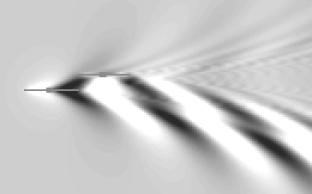
A sample wake wave calculation from
the Michlet program, showing an asymmetrical multihull configuration that
leaves most of the wave energy on one side.
Surface-piercing propellers
These will gradually supplant waterjets as the preferred
propulsive device for fast ferries. Surface-piercing propellers are well suited
for high speeds because they are generally not subject to cavitation damage,
replacing the vapor bubbles with entrained air brought down with each rotation
of each blade.
They are more efficient because the allow a larger
"actuator area" without compromising navigation draft or shaft angle.
Unlike fully submerged propellers, which are almost always too small and
turning too fast for best efficiency, surface-piercing propellers have almost
no practical diameter limitation. Coupled with appropriately deep reduction
ratios, larger slow-turning propellers leave less wasted energy in the
slipstream than fully submerged propellers, and much less than waterjets.
Fixed surface-piercing installations can also be
considerably less expensive than waterjets. But it will take time for the
industry to leave the current orthodoxy of waterjets for fast ferry
applications (Kamen, 1989, 1990). (Note however that two of the authors are
former employees of Arneson Marine, manufacturer of a surface-piercing
propulsion system.)
Wing in ground effect
:
Evolution is amazingly good at optimization, and useful
analogies can often be made to biological systems. When looking for natural
analogs to surface vessels, we find a total lack of any animal that travels any
significant distance by planing along the surface of the water. Similarly, we
find no hydrofoils in nature. What we do find - and we find them in abundance -
are birds and even fish that fly just above the surface in ground effect. In
nature it appears to be either wing-in-ground-effect or displacement mode, and
nothing in between seems to have survived to tell the tale.
The theoretical explanation is simple: As a hydrofoil moves
closer to the surface, the water becomes "soft." Upwash is reduced
because there is a reduced low pressure field to pull the flow up as it
approaches the foil, and downwash increases for the same reason. The flow is
increasingly asymmetrical fore and aft, induced drag increases, and performance
of the foil degrades.
But as a wing operating in air moves closer to the water
surface, the relatively "hard" boundary of the water imposes a plane
of symmetry that significantly reduces induced drag, and performance improves.
So whenever we have to operate at high speed near the
boundary between a dense fluid and a thin one, it makes much more sense to
derive all our lift from the thin one.
What does this imply for fast ferries?
Water is sticky stuff. When efficiency and high speed both
become the most important parameters, WIG designs will dominate.
However, because the economics of these vehicles will resemble
those of airplanes, the obvious question is, "why not just use an
airplane? Answer: The WIG ferry does not need to compete for airspace or
runways, both of which are in very short supply (Ebb, 1990)
Personal amphibians
Earlier in this paper we demonstrated that the economy of
scale is relatively weak for ferries. Because of crewing requirements tied
more-or-less linearly to the number of passengers, there is little savings in
crew costs for large ferries over small ones.
However, crew cost v. number of passengers is a step
function with some interesting characteristics. Below 149 passengers (assuming a single-deck configuration),
there is no reduction from the crew of two, so crew costs increase as the inverse
of the number of passengers.
But when the vessel becomes small enough to be
passenger-operated, this cost suddenly drops to zero.
A number of "boat-pools" (like van-pools) have
been operated at various times, and their popularity is likely to increase.
Private marinas, however, are seldom located at transit
nodes or close enough to downtown employment centers. This suggests a role for
the personal high-speed amphibious vehicle.
Two of the authors have developed a conceptual design for
such a vehicle. Unlike previous attempts at consumer amphibians, this one is
capable of moderately high speed when waterborne, and is easily retrofitted to
a wide range of existing vehicles.
As pressure to achieve urban mobility increases with
congestion, the market will almost certainly produce a viable high-speed
personal amphibian.
Electronic ticketing and faster boarding
Ferry system planners are beginning to realize that the time
spent boarding or leaving the ferry does, in fact, "count" against
trip time. For a typical urban route of six miles, a minute saved at the
terminal is equivalent to increasing speed from 18 knots to 19. This is a speed
increase that would require about a 17% increase in installed power, and an 11%
increase in fuel consumption per trip. Big doors and wide gangways are cheaper.
One of the decisions facing the designer of a ferry system
is the location of the "control point" for ticketing.
For fastest loading the control point should be on the pier,
so that all passengers are "inside" the paid system and ready to
board when the ferry arrives. The disadvantages of the on-shore control point
are that boarding areas have to be larger, passengers have to wait in a
restricted area, and passengers cannot take advantage of nearby commercial
services while they wait.
Controlling at the gangway, however, slows down boarding and
increases trip time.
Collecting tickets after boarding, railroad style, is
subject to abuse and for large ferries, places unreasonable demands on the
crew.
Electronic ticketing, a la the CalTrans "Fastrak"
now in use at bridge tollbooths, is a fairly straightforward solution. Although
the control point is at the gangway, the electronic debiting of the ticket has
no effect on the speed of boarding.
Dual mode - a new paradigm for ground transportation
Despite the tireless efforts of transportation planners,
environmentalists and politicians to get people out of their cars and into
public transportation, the brutal reality is that the personal automobile is
here to stay. This is not as bad as it might sound, however. Various versions
of the "dual mode" scheme promise to combine the convenience of the
car with the efficiency of the train.
In a dual mode transportation system, individuals own small
private vehicles that they park at home. These can be electric, hybrid or
engine-powered when they are operated autonomously by their owners on local
roads. On the freeway, they enter a guideway system and are
computer-controlled, powered (and recharged) by the guideway, and can link up
into trains to minimize air resistance and maximize vehicle density. A good example of a dual mode prototype is
the "RUF" system developed in Denmark (Jensen, 2000).
How does this affect ferry design?
The dual mode vehicles occupy less than one-quarter of the
volume taken up by conventional cars. They are much more standardized with
respect to size and shape. And best of all, they are designed to be controlled
remotely when on a guideway, so it is not necessary for the passengers to drive
them onto a ferry. This means that the there is no need to provide clearance
for the doors to open, and no need for standing headroom on the car decks.
Fully automated and optimized loading and unloading of the vehicles will be
extremely fast and efficient, irrespective of whether the cars are moving forwards
or backwards.
Dual mode vehicles will stack into a ferry so efficiently
that we believe it is safe to predict the return of the car ferry, even on
urban routes that parallel existing bridges and tunnels. That is, if dual mode
every becomes a reality on land, dual mode adapted car ferries will follow.
Meanwhile, and more within the time frame of our own life
expectancies, we will probably see an increasing tolerance of small electric
scooters along with bicycles on urban ferries.
CONCLUSIONS
"God intended people to travel by ship"
Cedric Ridgely-Nevitt
Ferry systems are economically and politically justified
even with substantial subsidy, but system designers have a duty to make sure
that the systems are as cost and environmentally effective as possible.
Passenger capacity (especially over 149 passengers) and
speed need to be very carefully considered and justified. Both are expensive, and other approaches may
be less expensive and more effective in attracting riders and protecting the
environment.
Environmental issues need to be very carefully analyzed,
looking through the whole lifecycle of and supply chain of a system. Simple answers can do more harm than good.
The intermodal portion of the system is at least as
important as the marine portion and probably more so.
The construction of ferries in the region served is a
worthwhile goal and is feasible, even in a high wage area by using both
established and innovative techniques for modern shipbuilding.
There are numerous innovations, some silly, others
worthwhile, and some appearing to be one while actually the other. The authors have thrown out a few and leave
it to the readers to judge which category they fall in, but the point is that
there are a lot of ideas out there and marine professionals need to contribute
their own, and be open to those of others. However, it is important to
understand which are for now and which are for later, and to avoid making too
many promises.
Returning to the theme of the frontispiece, we note that
many ferry planners specify commercial off the shelf (COTS) vessels or proven
parent craft. This is sometimes even
required by law. One of the authors
chose a “Toller” as a companion animal, because its tolling behavior gives it a
playful nature and it has the temperament and the intelligence of the retriever
breeds, but because they often traditionally work from a canoe, they are much
smaller than other retrievers – or a boxer, for that matter. However, the “Nova Scotia” part gives it a
heavy double coat and furred webbed feet, both of which require substantial
grooming effort. Changing the task or
environment of a dog requires acceptance of compromises because dogs are not
available other than COTS with any real predictability. This is not the case for a boat and the science
of naval architecture is sufficiently well advanced that a predictable,
reliable ferry with the desired characteristics, and only those characteristics
is usually possible. In this regard, we
advise the WTA, when it finally specifies vessel designs, to specify interface
and other requirements but not to specify vessel solutions. Leave that to the designers and shipyards
and allow them to propose their best solutions, taking into account their
processes, designs and skills. We also
note that “slight” modifications of a proven parent have been seen to be a very
good way to get into trouble, especially those that add weight to high speed
craft. The parent was presumably
optimized, and a modification by definition moves it off optimum, and perhaps
even over the edge.
We advise that, in the course of their mandated studies,
that the WTA do “validation” designs to confirm that their requirements are
achievable, to estimate the costs and other possible impacts, trade-offs, or
opportunities, rather than to determine that a particular design or concept is
the solution. This is a very important
step in any acquisition process, and a valuable learning experience to scrub
and clarify the requirements documents.
This may even lead to changes in the overall mission. However, once the validation design shows,
for example, that an aluminum catamaran with surface drives can meet the
requirements, all that has been shown is that there is at least one way to skin
that “cat”. A shipyard or a designer
may come up with a better way, or one as good but cheaper, and the only way to
find out is give the offerors as much latitude as possible and just look at
what comes in when proposals are due.
The Society of Naval Architects and Marine Engineers needs
to become much more prominent and visible in ferry design and overall system
design issues, especially as regards the interaction of system design and
vessel design. The position paper on
ferries was an excellent start, but the fact that even the staff list of the
WTA does not use the term “naval architect” suggests more visibility in this
area may be needed.
We also have a vision of the Bay Area becoming a leading
center of innovative ferry systems like that of the 1999 study, and further
note that UC Berkeley has a department of naval architecture and ocean
engineering. We would like to further
suggest that some form of long term sponsored research and development might be
appropriate and pay dividends far beyond its costs.
REFERENCES
Akers, R.,
“Dynamic Analysis of Planing Hulls”, New England Section, SNAME, 1999
Barry, C.
and Duffty, B., “The Stepped Hull Hybrid Hydrofoil”, Fast 99, SNAME, New Jersey,
August 1999
Barry, C.,
Oetter, R. Lane, K., and Mercier, L., “Keys To CAD/CAM In Small Shipyards”, Transactions,
SNAME, New Jersey, 1998
Blankenship,
K., “Native Grass Could Help Fuel Bay Cleanup” Bay Journal, 11:9, December
2001
Blume, A.,
“Managing Wake Wash from High-Speed Vessels: An Overview of Guidelines Being
Developed by PIANC”, 17th Fast Ferry Conference, New
Orleans, LA, 2001.
California State Legislature, Senate Bill No. 428, October
1999
Case, J.,
“The Sea Bus Story, Part 1: History, Design Construction, and Operation of a
Marine Rapid Transit System” Marine Technology 18:4, SNAME, New Jersey,
October 1981
Coldwell, J., The Love of Tollers, Littleriver, Canning,
NS, 2000
Ebb, M., Latitude 38, June 1990
Ebb, M., Latitude 38, September 2001
Fulz, J.,
“White Paper on Marine Exhaust Filtration and Water Separated Exhausts” Project
2001, METS
Amsterdam, Eco Sound Inc., Florida
Hockenberger,
W., “Determining The Right Ferry: An Economic Decision Methodology”, Transactions,
SNAME, New Jersey, 1996
Hockenberger,
W., “Determining The Market For Fast Passenger Transportation”, Annual
Meeting, SNAME, New Jersey, 2001
Jensen, Palle R. : "The RUF System" New Visions in Transportation, NVT2000,
Aspen, Colorado, 2000
Kamen, P.,
Railton, D., "Application of Surface Propulsion Systems", Society of
Naval Architects and Marine Engineers, Northern California Section, 1989.
Kamen, P.
"Is there a Surface Drive in your Future?" Professional Boatbuilder, December/January 1990.
Karafiath,
G., An
Investigation Into the Performance of NSRDC Model 5184 Configured as a Partial
Hydrofoil Supported Planing Craft and a Comparison with a Powering Prediction
Technique, Report SPD-585-01, NSRDC, 1974
Long, R.
“Bay Area Transit Options Emissions Report”, Bluewater Network, San Francisco,
1999
Michlet
wake and resistance simulation
http://www.maths.adelaide.edu.au/Applied/llazausk/software/michlet/michlet.htm
McGregor,
P., Valley Transportation Authority, Personal Correspondence/Survey, October
2001
Marron,
H., “Gas Turbine Waste Heat Recovery Propulsion For U.S. Navy Surface
Combatants”, Naval Engineers Journal, 93:5, American Society of Naval
Engineers, Alexandria VA, 1981
Migeotte,
G. and Hoppe, K., “Design and Efficiency of Hydrofoil Assisted Catamarans”, Fast 2001,
Royal Institution of Naval Architects, London, 2001
Oetter,
R., Barry, C., Duffty B., and Welter, J., “Block Construction Of Small Ships
And Boats Through Use Of Developable Panels”, Ship Production Symposium, and
Journal
of Ship Production SNAME, New Jersey, June, 2001, and May, 2002
Sharke,
P., “Making A Clean Getaway”, Mechanical Engineering, ASME, Chicago, January
2002
Shrank, D.
and Lomax, T., The 2001 Urban Mobility Report Texas A&M University, May
2001
Sweeney,
J. (Chairman, ad hoc Ferry Transit Environmental Impact Panel, et al),
Ferry
Systems For The Twenty First Century SNAME, New Jersey, 2000
Tuck, E.O.,
Lazauskas, L., "Wave Cancellation by Weinblum type Catamarans and
Diamond-shaped Tetrahulls," EMAC'98,
3rd Biennial Engineering Mathematics and Applications Conference, Adelaide,
1998
Ulak, A.,
Akers, R., Barry, C., and Ghosh, D. “Implementation, Application and Validation
of Zarnick Strip Theory Analysis For Planing Boats”, High Performance Yacht Design
Conference 2002, University of Auckland, New Zealand,
Dec., 2002 (Accepted)
Urbach,
H., Garman, R., Knauss, D., Watts, J., Dwan, T., Mitchell, E., and Howes, C.,
“A Steam-Augmented Gas Turbine with Reheat Combustor for Surface Ships”, Naval
Engineers Journal, 106:3, American Society of Naval Engineers,
Alexandria VA, 1994
Vuchic,
V., Urban
Public Transportation Systems and Technology, Prentice Hall, Englewood
Cliffs NJ, 1981
WEBLIOGRAPHY
Nova Scotia Duck Tolling Retrievers
http://toller1.com,
http://www.nsdtrc-usa.com
Water Transit Authority
http://198.31.87.64/index.shtml
Bay Area Council Blue Ribbon Task
Force
http://www.bayareacouncil.org/watertransit/index.html
"New Proposals for a Berkeley
Ferry"
http://www.well.com/user/pk/waterfront/Ferry/index.html
The RUF dual mode transportation system
http://www.ruf.dk/
Surface-piercing propellers
http://www.well.com/user/pk/SPAprofboat.html
Berkeley's opposition to the WTA
http://www.ci.berkeley.ca.us/citycouncil/1999citycouncil/summary/072799SB2.html
The Sierra Club's position paper on
ferries
http://www.well.com/user/pk/waterfront/Ferry/SierraClubLetter.html
The Michlet program for resistance and wake wave prediction
http://www.maths.adelaide.edu.au/Applied/llazausk/software/michlet/michlet.htm
The views and opinions expressed are those of the authors and are not
to be construed as official policy or reflecting the views of the U S Coast
Guard or the Department of Transportation.
APPENDIX A: A DETAILED PLAN FOR A BERKELEY TO SAN FRANCISCO FERRY SERVICE
"Even a journey of a thousand miles begins with a
two-hour schlep to the airport"
Chinese proverb (slightly modified)
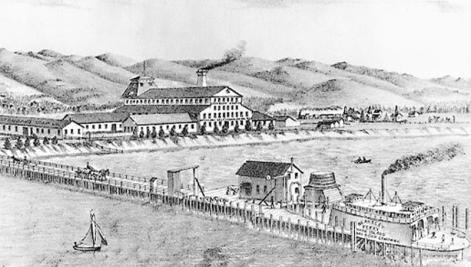
Jacob's Landing in the
late 19th Century. (Note the feed water tank on the pier.)
Background
Ferry service from Berkeley to San Francisco began in 1851
when James H. Jacobs built the wharf at the mouth of Strawberry Creek, and
ended in 1956 when the last scheduled ferry left the end of the Berkeley
Municipal Pier. The Bay Bridge (1936), the proliferation of the private auto,
and finally transbay BART service (1973) all made ferries redundant and
obsolete.
Temporary ferry services have operated during a BART strike
(1979) and during the closure of the Bay Bridge following the Loma Prieta
earthquake (1989).
But the boats were old and slow, the docking arrangements
inside the Berkeley Marina were time consuming and the ridership could not be
maintained.
Even in the weeks following the Loma Prieta earthquake with
the Bay Bridge closed, there were never more than 500 morning commuters taking
the ferry.
What the ferry can and cannot do
It is recognized that a Berkeley ferry is not likely to
significantly alleviate vehicular congestion or improve regional air quality.
It is primarily an amenity and an alternative to other forms of private and
public transportation. However, because it will be possible to operate this
ferry service without significant public subsidy, funds will not be redirected
from other modes of public transportation. The probable lack of measurable
impact on Bay Area traffic congestion is therefore not a valid argument against
the ferry service proposed here.
What the Berkeley ferry will do is increase mobility. Ferry
service has become desirable again because of the chronic congestion on the Bay
Bridge and the saturation of the BART system. For example, for those who do not
live within walking distance of a BART station, after about 8:00 am when the
BART parking lots fill up there are essentially no options but to drive to San
Francisco. Crossing the bridge by car on a weekday morning (or Saturday
evening) is unpleasant and very slow, and parking is expensive. The loss of the
ability to move about the inner Bay Area freely and comfortably has a high
economic cost, and ultimately adds to the pressure for suburban sprawl.
The Boat
The type of vessel proposed is a 149-passenger single-deck
catamaran, designed to operate at a speed of 18 knots. It will be powered by
two diesel engines of approximately 600 hp each, and operate with a crew of
two. 18 knots is relatively slow by modern standards, but it is fast enough to
cover the 5.6 mile route in less than 20 minutes. This is barely enough time to
buy a latte, turn on the cell phone and open up the computer. That is, a faster
trip will not be any more saleable than the proposed 20-minute timing.
More important is efficient ticketing and very fast loading
and unloading. This will have a greater effect on trip time than a few knots of
additional speed.
The 149-passenger size is dictated by Coast Guard rules. For
150 passengers or more there are substantial additional fire safety and other
structural requirements that begin to take effect, and these significantly
increase the cost of the vessel. The single-deck design limits the number of
crew required to two.
To keep the propulsion system small and clean, and to keep
the cabin free of noise and vibration and uncomfortable vessel motions, a
catamaran configuration with long slender hulls is proposed. This also results
in a lot of inexpensive outside deck space for bicycles and possibly electric
scooters.
Emissions controls would be similar to those used on modern
busses. Because of the low speed, however, the horsepower per seat is
comparable to that found on a city transit bus.
Location of the terminal
This proposal calls for a ferry service that more closely
resembles the service of 100 years ago. Rather than use the existing ferry dock
inside the Marina, there would be a new terminal in the open water alongside
the Berkeley Fishing Pier. This location has several compelling advantages:
1) It is the closest to San Francisco. The 5.6-mile route
will only take 20 minutes at a modest speed of 17 knots. This is about a mile
closer than other suggested locations at the foot of Gilman Street or Fleming
Point (behind the race track).
2) There will be no wasted time maneuvering in and out of
the Marina.
3) Little or no dredging is required, unlike the foot of
Gilman Street or at Fleming Point that would require extensive dredging
projects.
4) The Berkeley Pier is at the end of the AC Transit 51 M
bus line. Because this is the terminus
of a major trunk line, there is very frequent service (about every 20 minutes
all day), yet ridership is low because it is near the end of the line. It is a
natural location for an intermodal transfer. Rather than requiring new bus
service, this location would make use of existing excess capacity at the end of
an existing route.
5) There are 410 parking spaces in the parking lot serving
Hs. Lordships restaurant and along Seawall Drive south of the Pier. These are
mostly unused during the week. Other overflow parking areas are nearby in the
Marina. Peak demand hours for ferry parking generally miss the peak demand
periods for Marina parking, so this would also take advantage of existing
infrastructure rather than requiring new facilities.
6) There is existing nearby commercial activity (unlike the
proposed Gilman Street location, where commercial development is in question).
Commercial activity makes the ferry terminal a more attractive place to wait or
to meet, and the presence of the ferry is likely to increase public revenue
from the nearby businesses.
7) The ferry route would not have to traverse any part of
the Eastshore State Park. Sierra Club and other groups have opposed commuter
ferry service to any location in Berkeley or Albany on the grounds that it
would not be compatible with the Eastshore State Park. The Berkeley Pier
location is furthest from the park boundaries, and does not traverse any park
tidelands.
The Politics
The Sierra Club is on record as strongly opposing a commuter
ferry operating from anywhere along the Berkeley or Albany waterfront. This
opposition appears to be based primarily on the prospect of a larger and faster
ferry operating from the foot of Gilman Street, an area that the Sierra Club
hopes will eventually be acquired by the State and become part of the Eastshore
State Park.
These considerations should have no relevance to the this
proposal, which is well removed from the Eastshore State Park land and
tidelands.
Sierra Club has, however, raised the objection to
ferry-related traffic transiting the Eastshore State Park on University Avenue.
The numbers, however, don't support the claim that this would cause a
detectable qualitative change in the traffic level. With a maximum capacity of
149 passengers and three departures every morning, it is hard to imagine how
the four lanes of University Avenue would become congested. Considered in the
context of the number of seats in existing waterfront restaurants, activities
at other Marina businesses and offices, and the number of boat berths served by
those same roads, the traffic argument becomes specious.
If we conservatively assume a capacity of 500 cars per hour
per lane, and three full ferries with every seat representing another car, then
we have only used 26 minutes of road capacity for the entire morning commute.
On the other hand, several interest groups can be expected
to offer strong support for a Berkeley ferry.
The bicycle groups - East Bay Bicycle Coalition and Bicycle
Friendly Berkeley - are ferry advocates. BART is closed to bicycles during
commute hours, while a ferry with a large bicycle deck promises the efficiency
of a true dual mode personal/public transportation system.
Handicapped advocacy groups are expected to show favorable
interest. Ferries are spacious and easy to use, and offer safe mobility for
people with a wide range of disabilities.
People who like to travel with their dogs are likely to be
strong ferry advocates. There is no reason to preclude dogs from the outside
deck areas of a ferry operating on a short route.
As we have seen from various public planning processes, the
combination of bicycles, dogs, and the handicapped comprises a formidable
lobbying force. Even in Berkeley, the Sierra Club would be ill advised to
oppose it.
The Fare Structure
If we make some very conservative assumptions about costs,
the back-of-the-envelope economic analysis suggests that the required
break-even no-subsidy ticket price is $9 each way. This covers vessel
construction and operation, and assumes 2/3 full on the forward commute, 1/3
full on the reverse commute, seven round trips per day, and about $400/hour for
total operating expenses.
$9 is steep, but this is the same ticket price as the
Vallejo ferries and not that much more than the $6.75 charged for the Sausalito
and Tiburon ferries. It compares favorably with the cost of parking in downtown
San Francisco for the day, or the cost of a trip on an airport shuttle. As long
as the boat is small and the service is not too ambitious, there is probably a
sustainable market at this price point.
However, the market-rate ticket exposes the ferry proposal
to charges of elitism, and the criticism that the service is designed to serve
only the rich. There is some truth to these charges, so the strategy proposed
here is to implement a policy analogous to that in effect on the major toll
bridges. On the bridges, carpools go free. The rationale for this policy is
that they tread lightly on both the environment and the transportation
infrastructure, and help alleviate the congestion of single-occupancy vehicles.
On the ferry, anyone arriving by bicycle and bringing it
aboard would ride free. The rationale is the same as on the bridges. This would
insure that the ferry remains accessible to the widest possible range of income
levels, without relying on public funds or complicated and inefficient subsidy
schemes. It would also immensely simplify ticketing and boarding for
bicyclists.
This scheme is of course is experimental, and its success
would depend on both its popularity and the level of abuse that could not be
prevented by the obvious countermeasures. The free ride might have to be
replaced by a deep discount after some operational experience is obtained.
Discounts would also be offered for the "reverse"
commuters, SF to Berkeley in the morning and westbound in the afternoon.
Parking is scarce and expensive at the San Francisco ferry terminal, so the
discount could be justified on similar environmental/infrastructure grounds, if
not on simple supply and demand. Reverse commute discounts would be extremely
valuable to a significant number of students at U.C. Berkeley, as well as some
City employees
The Schedule
Because of the low subsidy level, the schedule must be
driven by cost and revenue considerations. As long as there is a place to park
at BART, the ferry can never hope to compete with BART for level of service as
measured in convenient access to the terminals or stations.
But BART parking lots fill up early in the morning. They are
generally full by 8:00 am on weekdays. Although a small number of spaces become
available at 10:00, and can be reliably accessed between 10:00 and 10:05, for
all practical purposes BART is not an easy option after 8:00 am. Certainly
there are many people who can walk, bike, or bus to the BART station. And while
we acknowledge that these people hold the moral high ground, for the majority
of riders the only viable means of travel to the station is access by private
auto.
There is not point, then, in scheduling a ferry departure
before 8:00 am. With 20 minute transit time an hourly schedule is feasible
using one boat, so the proposed morning departures would be at 8, 9, and 10.
After the 10 am departure it is assumed that the demand will
fall below the level that would support an hourly schedule. The problem becomes
one of keeping the boat busy during the mid-day lull. Assuming the crew's work
day has started at 7:30, the crew has only been on watch for three hours when
the ferry is finished unloading at the Ferry Building at 10:30.
We propose the route topology shift from part of the 'hub and
spokes" system centered around SF to a circular route around the central
bay, keeping the legs short enough to be compatible with the relatively slow
speed.
After leaving the Ferry Building, the ferry would begin a
clockwise circuit to Sausalito, Tiburon, Larkspur and Richmond, returning to
Berkeley in time for a 1:00 pm departure.
The next loop would include a stop at Treasure Island, then
SF, Sausalito, Tiburon, Larkspur and Richmond, returning to Berkeley for a 4:30
pm departure.
The 4:30 pm departure be in SF in time for a 5 pm return
commuter run straight back to Berkeley. Hourly departures would continue at 6,
7, and 8 pm.
The boat is finished for the evening at 8:30 pm, and the
crew could probably punch out at 9. This is a 13.5 hour day, presumably done as
one 7:30 am 1:00 pm shift of 5.5 hours,
and one 1:00 pm - 9:00 pm shift of eight hours.
The mid-day circular routes provide one trip from the East Bay
to Treasure Island, and two trips each to the three terminals in Marin. This
would fill an important gap in transit mobility, as there is currently no easy
way to travel from the East Bay to Marin.
Note that there are four evening commuter return trims, but
only three morning trips. This apparent imbalance is account for two factors:
1) a significant number of morning commuters will be pulled away by informal
carpools, attracted to the HOV lane to the Bay Bridge. Although other transit
agencies have resisted and discouraged this practice, the ferry service should
recognize the value of the informal carpool phenomenon and accommodate it as
much as possible. 2) There is typically a much wider distribution of return
times than departure times. People work late, run errands, and have other
reasons to delay their return trip, suggesting the four-trip three-hour return
window.
Here is what the tabulated schedule might look like:
Treasure
San
Berkeley
Island Francisco Sausalito
Tiburon Larkspur Richmond Berkeley
8:00 8:30 9:00
9:00 9:30 10:00
10:00 10:30 11:00 11:30 12:00
12:30 1:00
1:00 1:30
2:00 2:30 3:00 3:30
4:00 4:30
4:30 5:00 5:30
5:30 6:00 6:30
6:30 7:00 7:30
7:30 8:00 8:30
On the other hand, the public might be better served by a
simpler schedule, with hourly service all day:
Berkeley San Francisco Berkeley
8:00 8:30
9:00
9:00 9:30
10:00
10:00 10:30
11:00
11:00 11:30 12:00
12:00 12:30 1:00
1:00 1:30 2:00
2:00 2:30
3:00
3:00 3:30
4:00
4:00 4:30 5:00
5:00 5:30
6:00
6:00 6:30
7:00
7:00 7:30 8:00
Economics
Assumptions:
First cost of ferry: $4 million
Operating cost (crew, fuel, maintenance, admin): $400/hour
Port fees in San Francisco: $20,000/year.
Terminal construction in Berkeley: $2 million.
Occupancy:
2/3 full fare passengers on seven forward commutes.
1/3 full fare passengers on seven reverse commutes.
1/3 full fare passengers on one mid-day circle route.
12.5 operating hours/day, 255 commute days/year.
Calculations:
Total fares/year = 255 x (149 x 7 x 2/3 + 149 x 7 x 1/3 +
149 x 1/3)
= 278,630
full fares/year.
Capitalization = $6 million x 0.1 = $600,000/year.
Operation = 255 x 12.5 x 400 + $20,000 = $1,150,000/year.
Total = $1,750,000/year.
Required fare for unsubsidized break-even = $1,750,000/278,630
= $6.28.